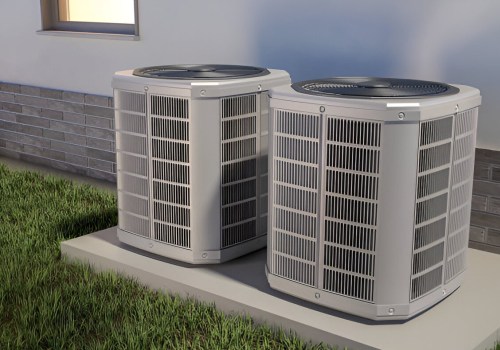
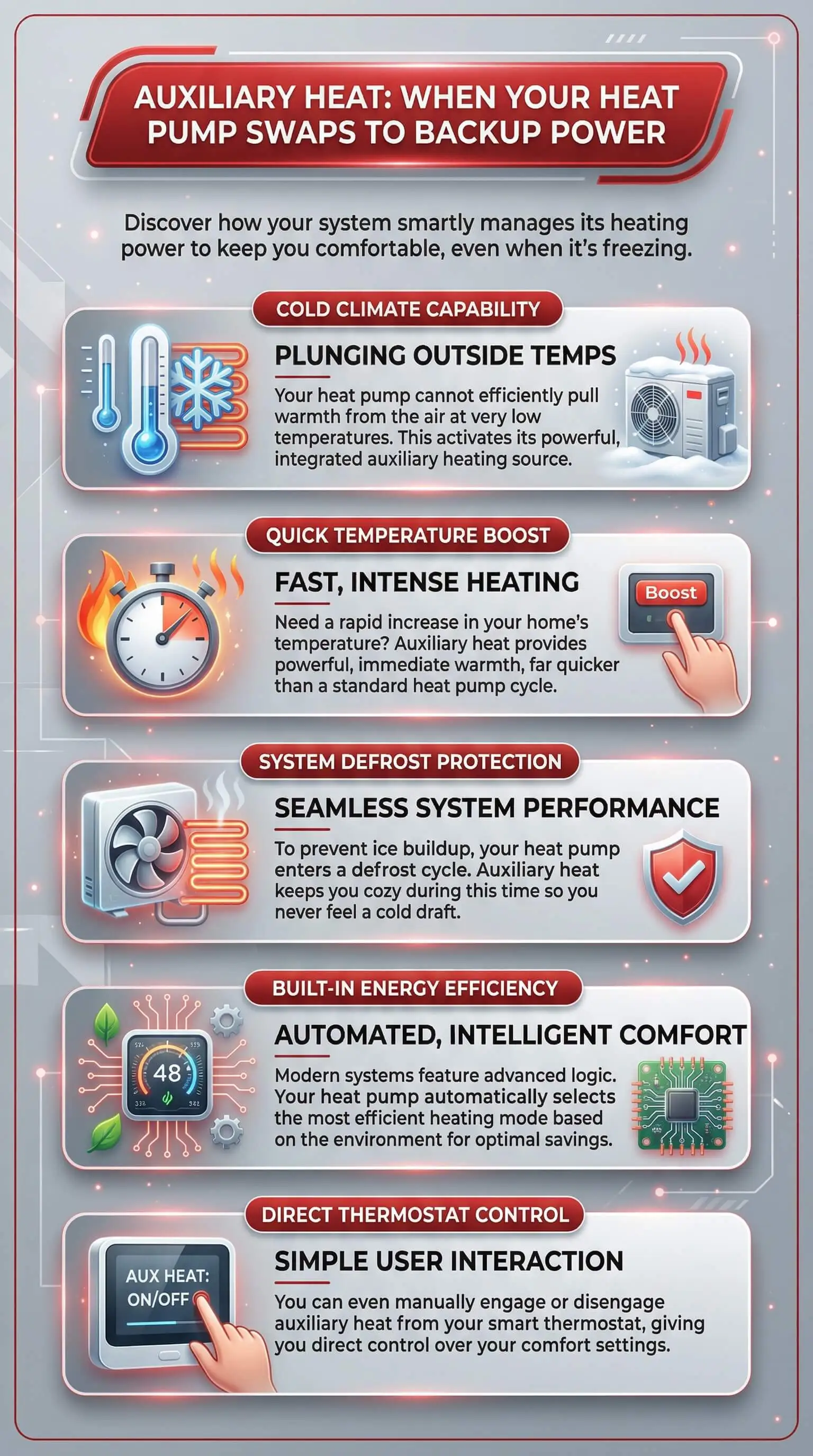
When outdoor temperatures fall below a system-specific threshold, built-in sensors and thermostat logic detect that the heat pump can no longer extract sufficient heat from the outside air on its own. At that point, the answer to what does auxiliary heat mean is a positive one: your system is automatically providing the extra warmth needed to keep your home comfortable and your temperature steady.
In our experience servicing heat pump systems across thousands of homes, the "Aux Heat" indicator on the thermostat is one of the most misread signals a homeowner encounters. It looks like a warning. It isn't always one. But knowing the difference — and understanding exactly what triggers that activation — is what separates homeowners who manage their comfort confidently from those who call for service unnecessarily.
This page breaks down how your heat pump makes that call, what conditions and temperature thresholds drive it, and how to tell normal operation from a system that genuinely needs attention.
TL;DR Quick Answers
What Does Auxiliary Heat Mean?
Auxiliary heat is your heat pump's automatic backup heating system. It activates when outdoor temperatures drop below your system's balance point — typically between 30°F and 40°F — and your heat pump can no longer meet your home's heating demand on its own.
Key facts:
Auxiliary heat works alongside your heat pump — both systems run together
It is triggered by cold outdoor temperatures, defrost cycles, or large thermostat adjustments
The "Aux Heat" indicator on your thermostat is a status light, not a warning
Auxiliary heat uses electric resistance heating — less efficient than your heat pump
Normal during cold weather — abnormal when running on mild days above 40°F
Not the same as emergency heat, which shuts the heat pump down entirely
The single most important thing to know: auxiliary heat activating occasionally is your system working correctly. Auxiliary heat running constantly is your system telling you something is wrong.
Top Takeaways
Auxiliary heat activation is normal — but context is everything. Seeing "Aux Heat" during a hard freeze, a defrost cycle, or after a large thermostat adjustment means your system is working correctly. The same indicator on a mild day with no setpoint change is worth investigating.
Auxiliary heat and emergency heat are not the same thing. Auxiliary heat works alongside your heat pump automatically. Emergency heat bypasses the heat pump entirely and should only be used when the heat pump has failed. Confusing the two is one of the fastest ways to drive up your winter energy bill.
A dirty filter is one of the most overlooked triggers for unnecessary auxiliary heat. Restricted airflow causes your thermostat to call for backup heat even when the heat pump is functioning correctly. Changing your filter on schedule is the lowest-cost, highest-impact action you can take to protect system efficiency.
Incorrect thermostat wiring can cause auxiliary heat to run wastefully for years — with no obvious warning. The U.S. Department of Energy identifies improper control wiring as one of the most commonly violated heat pump installation practices. If auxiliary heat activates frequently regardless of outdoor temperature, a professional inspection should be your first call.
Your system's balance point — not a malfunction — determines when auxiliary heat engages. Most heat pumps are set between 30°F and 40°F. Below that threshold, the system can no longer meet your home's heating load on its own and backup heat takes over. Knowing your balance point is the single most important factor in understanding whether your auxiliary heat is operating normally.
How Your Heat Pump Monitors Outdoor Temperature
Heat pumps are designed to move heat — not generate it. They pull thermal energy from outdoor air and transfer it inside. But outdoor air has limits, and so does the heat pump's ability to extract from it.
Most heat pump systems are programmed with a balance point — typically between 30°F and 40°F depending on the equipment and climate — where the system begins to lose heating efficiency. Below that threshold, the heat pump can no longer keep pace with your home's heat loss on its own.
When that gap opens up, the system doesn't struggle silently. It calls for backup.
What Triggers Auxiliary Heat Activation
Your thermostat is the decision-maker. It continuously compares your home's current indoor temperature against the target setpoint. When the heat pump runs but your home temperature drops — or fails to rise — the thermostat registers the deficit and activates auxiliary heat to close the gap.
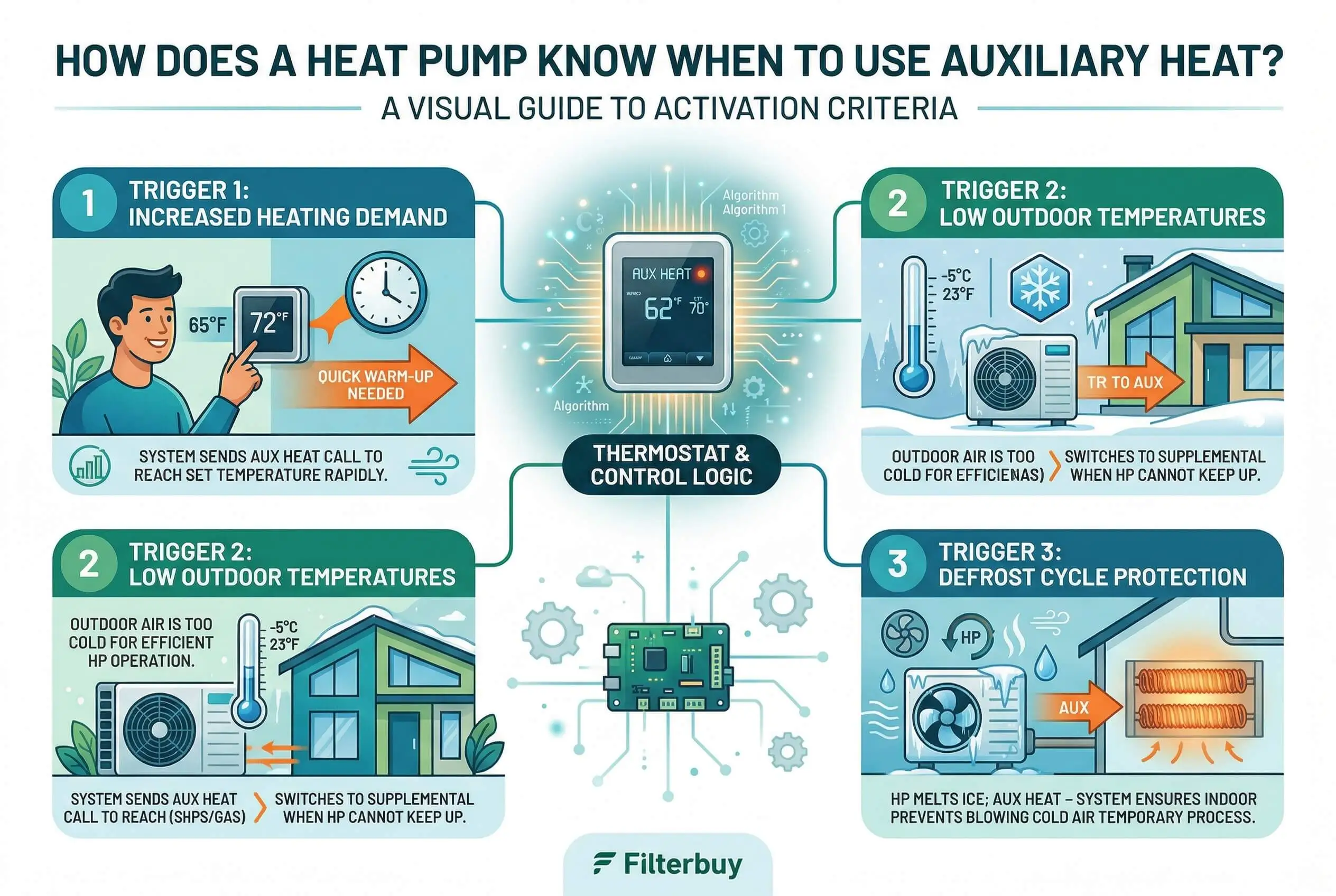
Three primary conditions trigger auxiliary heat:
Outdoor temperatures fall below your system's balance point
Your thermostat setpoint is raised by 2°F or more at once, creating a large demand the heat pump can't meet quickly on its own
The heat pump enters a defrost cycle and temporarily stops producing warm air, requiring backup heat to prevent a cold air blast through your vents
In our experience working on heat pump systems across a wide range of climates, the defrost-cycle trigger is the one most homeowners don't expect. The system isn't broken — it's doing exactly what it was designed to do.
The Difference Between Auxiliary Heat and Emergency Heat
This is one of the most common points of confusion we see, and it matters.
Auxiliary heat activates automatically alongside the heat pump when conditions require it. The two systems work together. Emergency heat, by contrast, bypasses the heat pump entirely and runs only the backup heating element — typically electric resistance strips. It's far less efficient and is intended only when the heat pump itself has failed.
If your thermostat is set to Emergency Heat and the heat pump is running fine, you're spending significantly more on energy than necessary. Emergency heat should be a last resort, not a default winter setting.
Why a Dirty Air Filter Makes This Worse
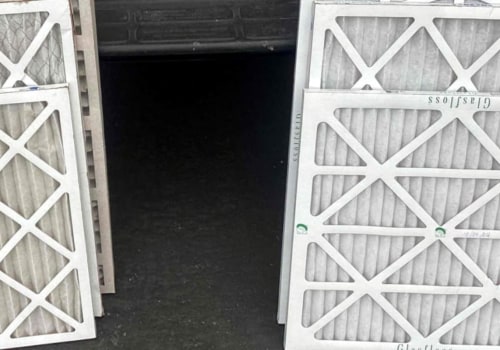
Here's something competitors won't tell you directly: a clogged air filter is one of the fastest ways to push your heat pump into auxiliary heat prematurely, which is why choosing a top air filter can make a meaningful difference.
When airflow is restricted, the system can't move conditioned air efficiently through your home. The thermostat registers a heating shortfall — even if the heat pump itself is functioning correctly — and brings auxiliary heat online to compensate. The result is higher energy bills driven not by cold weather, but by a filter that needed to be replaced.
After serving over two million households, we've seen this pattern repeatedly. Homeowners troubleshoot their heat pump, schedule service calls, and ultimately discover the root cause was restricted airflow from a neglected filter. A MERV 8 filter changed on schedule costs a fraction of what a single unnecessary service visit does — and protects the system from the strain that leads to real repairs.
How to Know If Your Auxiliary Heat Is Working Normally
The "Aux Heat" light on your thermostat is not a warning light. It's a status indicator. Seeing it on during very cold weather or after a significant thermostat setpoint adjustment is completely normal.
What isn't normal:
Auxiliary heat running continuously on mild days (above 40°F)
Auxiliary heat activating every time the heat pump runs, regardless of outdoor temperature
Your home failing to reach the setpoint even with auxiliary heat engaged
A sudden spike in your energy bill without a corresponding change in weather
Any of these patterns signals that something in the system — the balance point setting, refrigerant charge, airflow, or backup heating element — needs professional attention.
"Most homeowners assume the 'Aux Heat' light means something is wrong with their system — but that's rarely the case. What actually concerns us, after working on heat pump systems across thousands of homes, is when auxiliary heat runs on a 45-degree day with no setpoint change and a clean filter. That's the system telling you something. A heat pump that constantly leans on its backup isn't just costing you more on your energy bill — it's compensating for an underlying problem that will only get worse. The most important thing a homeowner can do is keep their filter clean and know what normal operation actually looks like. Those two things alone prevent more unnecessary service calls than anything else we've seen."
Essential Resources
We get this question from homeowners all the time — and we genuinely want to make sure you have the right information before jumping to conclusions about your system. These are the resources we point neighbors to when they want to go deeper on how auxiliary heat works, what drives it, and how to manage it wisely.
Start Here: The Government's Plain-Language Guide to How Heat Pumps Actually Work
If you want to understand why auxiliary heat exists in the first place, this is the resource we'd hand to any neighbor asking the same question. The U.S. Department of Energy walks through exactly how air-source heat pumps operate, what a balance point means for your specific system, and when backup heat is supposed to engage — straight from the source, no sales spin. https://www.energy.gov/energysaver/air-source-heat-pumps
Not All Heat Pump Systems Are Set Up the Same — Here's What You Need to Know
One thing we've learned from working in homes across this community is that the system type matters enormously. Whether your backup heat is electric resistance strips or a gas furnace in a dual-fuel setup changes everything about how you interpret that "Aux Heat" indicator. This DOE overview helps you identify what you're actually working with — and that's the honest first step to managing it correctly. https://www.energy.gov/heat-pumps
The Hidden Reason Your Auxiliary Heat Runs More Than It Should
In our experience, most auxiliary heat overuse comes down to one thing homeowners rarely expect: thermostat controls that aren't set up right. This resource from the DOE's Building Science Education Solution Center explains how incorrect wiring and improper control settings cause backup heat to activate when your heat pump could handle the job on its own — and what a proper setup actually looks like. https://bsesc.energy.gov/sites/default/files/2024-09/CEE_Controls_for_a_HP_with_Secondary_Heating_for_Homeowners_TRC_12.12.23.pdf
Real Field Data on What Auxiliary Heat Actually Costs Homeowners
We've seen firsthand what happens to energy bills when auxiliary heat runs more than it should — especially during prolonged cold snaps. This National Renewable Energy Laboratory research backs up what we see in homes every day: excessive backup heat activation is one of the most significant and avoidable drivers of winter energy costs for heat pump households. https://www.nrel.gov/docs/fy25osti/93074.pdf
How to Choose Efficient Equipment So You're Not Relying on Backup Heat to Begin With
The most effective way to reduce auxiliary heat dependence is starting with the right equipment. ENERGY STAR's certified heating and cooling product resource helps homeowners understand what to look for — and what certified performance actually means for your comfort and your monthly bill. It's the kind of guidance we'd share with our own family before a system replacement. https://www.energystar.gov/products/heating_cooling
Independent Research on Reducing Auxiliary Heat — Without the Manufacturer Bias
When homeowners ask us for an objective take on heat pump performance in colder weather, we point them here. The American Council for an Energy-Efficient Economy provides research-driven analysis that doesn't have a product to sell — just honest guidance on how to reduce backup heat reliance and what realistic expectations look like across different climates and home types. https://www.aceee.org/topic/heat-pumps
When Aux Heat Is Normal and When It's a Warning Sign — From Our Team's Direct Experience
This is the resource our own team put together based on years of servicing heat pump systems in homes just like yours. We cover what the "Aux Heat" indicator actually means, the specific conditions and temperature thresholds that trigger it, and how to tell routine operation from a system that genuinely needs attention. If you only read one resource on this list, make it this one. https://hvac.filterbuy.com/resources/how-to-guides-and-hvac-maintenance/what-does-heat-on-auxiliary-mean-is-it-bad-if-aux-heat-comes-on-thermostat/
These essential resources explain how auxiliary heat works, what causes it to turn on, and how top HVAC maintenance can help homeowners improve efficiency, reduce unnecessary backup heat, and make smarter system decisions.
Supporting Statistics
The numbers behind heat pump efficiency, auxiliary heat activation, and the real cost of getting it wrong show up directly on your energy bill. Here's what the research confirms — and what we've seen it mean in practice across thousands of homes.
Running auxiliary heat instead of your heat pump costs significantly more — every time it activates.
The U.S. Department of Energy confirms that today's heat pump reduces electricity use for heating by up to 75% compared to electric resistance heating. Auxiliary heat strips are electric resistance heating. That efficiency gap matters, especially during wildfires when energy efficiency and indoor comfort become even more important.
What we see in the field:
Unexplained spikes in January and February bills almost always trace back to auxiliary heat running more than it should
The heat pump itself is rarely the problem
The filter, thermostat calibration, or balance point setting usually is
Source: U.S. Department of Energy — Heat Pump Systems https://www.energy.gov/energysaver/heat-pump-systems
Incorrect auxiliary heat wiring is one of the most commonly violated heat pump installation practices in the country.
The U.S. Department of Energy identifies improper control wiring as one of the most frequently violated heat pump installation practices. Controls are incorrectly wired to activate backup heat strips whenever a thermostat is adjusted by more than 3 degrees — regardless of outdoor temperature.
What this looks like in a real home:
The system appears to be "broken" but is actually miswired from installation
Backup heat runs at electric resistance rates every time someone adjusts the thermostat
In some cases, this goes undetected for years
A qualified technician identifies this in the first ten minutes of a system inspection
Source: U.S. Department of Energy — Air-Source Heat Pumps https://www.energy.gov/energysaver/air-source-heat-pumps
A single undetected fault can push a heat pump into exclusive auxiliary heat operation — and most homeowners never see it coming.
National Renewable Energy Laboratory field research documented a case where an undetected sensor fault caused a system to run entirely on electric resistance auxiliary heat for weeks. Once corrected, auxiliary heat energy consumption dropped by 69% — through a colder winter.
What to watch for:
A system running on backup heat full-time won't always trigger error codes
The only visible signal is often a utility bill that doesn't match the weather outside
If energy costs are climbing and nothing about your usage has changed, auxiliary heat is the first place to look
Source: National Renewable Energy Laboratory — Minimizing Auxiliary Heat Use for Cold Climate Operation of Air-Source Heat Pumps https://docs.nrel.gov/docs/fy25osti/91366.pdf
A clogged air filter doesn't just affect air quality — it directly forces your heat pump into auxiliary heat and drives up your energy costs.
The DOE's Building Science Education Solution Center confirms that a dirty or clogged filter dramatically reduces airflow, increasing system run time, motor wear, and energy consumption. When airflow is restricted, the thermostat registers a heating shortfall and calls for backup heat — even when the heat pump is working correctly.
What we've learned serving over two million households:
Homeowners frequently schedule service calls convinced something is mechanically wrong
The root cause is often a filter past due for a change
A MERV 8 filter replaced on schedule is one of the lowest-cost, highest-impact actions a homeowner can take
It keeps auxiliary heat where it belongs: a genuine last resort, not a default winter setting
Source: U.S. Department of Energy — Building Science Education Solution Center, HVAC Proper Installation of Filters https://bsesc.energy.gov/energy-basics/hvac-proper-installation-filters
Final Thoughts
Most homeowners come to us thinking auxiliary heat is a problem to be solved. After working on heat pump systems across thousands of homes, our honest opinion is different — auxiliary heat is one of the most misunderstood and most informative signals your HVAC system sends you.
When auxiliary heat is doing its job, let it.
Activation during a hard freeze, a defrost cycle, or a significant thermostat adjustment means your system is working exactly as designed. That's not a warning. That's your heat pump protecting your family's comfort when outdoor conditions push beyond what it can handle alone.
When auxiliary heat becomes routine, that's when to pay attention.
These are the patterns that concern us:
Auxiliary heat running on a 45-degree afternoon
Backup heat activating every time the heat pump cycles
Energy bills climbing during a week of moderate weather
Those aren't signs of a system working. They're signs of a system compensating.
The most common culprits are also the most preventable.
In our experience, excessive auxiliary heat use almost always traces back to one of three things:
A filter overdue for a change, restricting airflow and forcing the thermostat to call for backup heat the heat pump should be handling on its own
A thermostat wired incorrectly from original installation, quietly running electric resistance heat for years without the homeowner ever knowing
A system undersized for the home's actual heating load, reaching its balance point earlier and more often than it should
None of these are emergencies on their own. But left unaddressed, each one steadily erodes the efficiency advantage that made a heat pump the right choice in the first place.
The homeowners who get the most out of their systems share one thing in common.
They know what normal operation looks like. Specifically:
They recognize the difference between auxiliary heat doing its job and auxiliary heat signaling a problem
They change their filters on schedule
They avoid dramatic thermostat adjustments
They act when something doesn't feel right — when the bill doesn't match the weather or the system runs harder than it used to
Understanding your heat pump doesn't require an HVAC certification. It requires knowing what questions to ask. That's exactly what this page was built to help you do — and the same guidance we'd share with any neighbor standing in their driveway asking us the same thing.
FAQ on What Does Auxiliary Heat Mean
Q: What does auxiliary heat mean on my thermostat?
A: Auxiliary heat is your heat pump's built-in backup heating system. In our experience, it's one of the most misread indicators on any residential thermostat. Here's what triggers it:
Outdoor temperatures drop below your system's balance point — typically between 30°F and 40°F
Your heat pump enters a defrost cycle and needs support maintaining indoor comfort
The "Aux Heat" indicator is a status light, not an alarm. After working on heat pump systems across thousands of homes, we can say with confidence: seeing it on during cold weather is normal. It's the same indicator running on a 50-degree afternoon that deserves your attention.
Q: Is it bad if my auxiliary heat comes on?
A: It depends on when and how often — and that distinction matters more than most homeowners realize.
Normal auxiliary heat activation includes:
During a hard freeze or sustained cold snap
During a heat pump defrost cycle
After a thermostat adjustment of 2°F or more
Abnormal auxiliary heat activation includes:
Running continuously on mild days above 40°F
Activating every time the heat pump cycles regardless of outdoor temperature
Running without any corresponding change in outdoor conditions
Abnormal patterns point to something specific — a dirty filter, incorrect thermostat wiring, low refrigerant charge, or an undersized system. None of those fix themselves.
Q: What is the difference between auxiliary heat and emergency heat?
A: This is one of the most important distinctions to get right — confusing the two costs homeowners real money.
Auxiliary heat:
Activates automatically alongside your heat pump
Both systems run together to meet heating demand
Normal operation during cold weather
Emergency heat:
Shuts the heat pump down entirely
Runs only the backup heating element
Heats your home exclusively with electric resistance heating — the least efficient and most expensive method available
Should only be used when your heat pump has completely failed
If your thermostat is set to emergency heat and your heat pump is operational, switch it back. You are spending significantly more than you need to.
Q: Why does my auxiliary heat keep coming on?
A: This is the service call we receive more than almost any other during winter months. The cause is almost always one of four things:
A clogged air filter restricting airflow — the most common trigger and the first thing to check
Incorrect thermostat wiring from original installation — the U.S. Department of Energy flags this as one of the most frequently violated heat pump installation practices
A thermostat setpoint raised too quickly — large adjustments trigger backup heat the heat pump can't meet on its own
A system undersized for the home's actual heating load — causing the balance point to be reached earlier and more often than it should
Start with your filter. If the problem persists after a fresh filter, the next call is to a qualified technician.
Q: How do I stop auxiliary heat from running so much?
A: Most unnecessary auxiliary heat use is correctable — and most of it starts with habits, not hardware. Here's what we tell every homeowner we work with:
Replace your filter on schedule — restricted airflow is the single most common trigger for auxiliary heat running when it shouldn't
Adjust your thermostat gradually — raise or lower setpoints no more than 2°F at a time to avoid triggering automatic backup heat activation
Keep your outdoor unit clear — snow, ice, and debris force more frequent defrost cycles and more auxiliary heat use
Schedule a professional inspection — a qualified technician should verify your balance point setting, refrigerant charge, and thermostat wiring
Consider a heat pump-specific thermostat — these ramp temperatures gradually by design, reducing unnecessary backup heat activation without any additional effort
If auxiliary heat continues running beyond what outdoor conditions justify after addressing these steps, the issue is mechanical. At that point, a professional inspection isn't optional — it's overdue.
Ready to Make Sure Your Heat Pump Knows When to Use Auxiliary Heat — and When It Shouldn't?
Schedule a professional heat pump inspection with Filterbuy HVAC Solutions today and let our experienced local technicians verify your system's balance point, thermostat controls, and filter condition — so your home stays comfortable and your energy bills stay where they belong.