TL;DR Quick Answers
top HVAC system replacement near Clermont FL
Top HVAC system replacement in Clermont starts with what we check before any quote: a Manual J load calculation matched to your home's actual cooling demand, a duct leakage test on the original flex duct in 1980s–90s subdivisions, and a CAC-licensed Florida contractor verified at MyFloridaLicense.com. Lake County's climate punishes shortcuts.
Top Takeaways
The Florida lifespan benchmark for residential HVAC sits at 12–15 years, not the national 15–20, because of year-round runtime and Lake County's 130–140°F+ summer attics.
Two or more warning signs from our seven-point diagnostic almost always means replacement is the better lifecycle decision.
R-22 systems with leaks rarely justify continued repair. The AIM Act and the 2020 phase-out have made reclaimed-supply pricing harder to absorb every year.
In 1980s–90s Hancock Road and Greater Hills subdivisions, the duct system usually needed to be replaced alongside the equipment for the new system to perform to its rating.
In 2000s+ master-planned communities, repair often stays viable through year 12. When replacement is needed, the upgrade to 16–18 SEER2 typically pays back faster than in cooler climates.
Why Clermont HVAC Systems Wear Out Earlier Than the National Average
The national lifespan benchmark for residential HVAC systems sits in the 15–20 year range, and Clermont systems rarely reach that ceiling. Lake County summer attic temperatures hit 130–140°F+ for weeks at a stretch, and our subtropical climate keeps cooling systems running essentially year-round. A unit that would last 18 years in Ohio routinely taps out at 12–14 years here. Three forces speed the wear: oak pollen and Lake Minneola humidity corrode condenser coils, year-round runtime stretches compressor cycles past what northern systems ever see, and indoor evaporators face humidity loads that don't exist in dry-air markets.
Locals call Clermont's rolling terrain the Choo Choo Hills. The elevation matters along the SR-50 corridor, where two-story homes have longer duct runs and more vertical air-handling demands. That extra workload highlights the importance of HVAC systems because it strains older blower motors faster than flat-lot construction would. Most of the systems we replace in Clermont show the same fingerprints of accelerated wear: corrosion at the suction line near the air handler, capacitors that swell after their fifth or sixth Florida summer, and compressor windings that run hotter than spec.
Seven Warning Signs That Tip the Balance Toward Replacement
We use seven diagnostic markers when we're deciding whether a system has reached the end of its serviceable life. When two or more show up together, replacement usually pencils out better than another round of repairs.
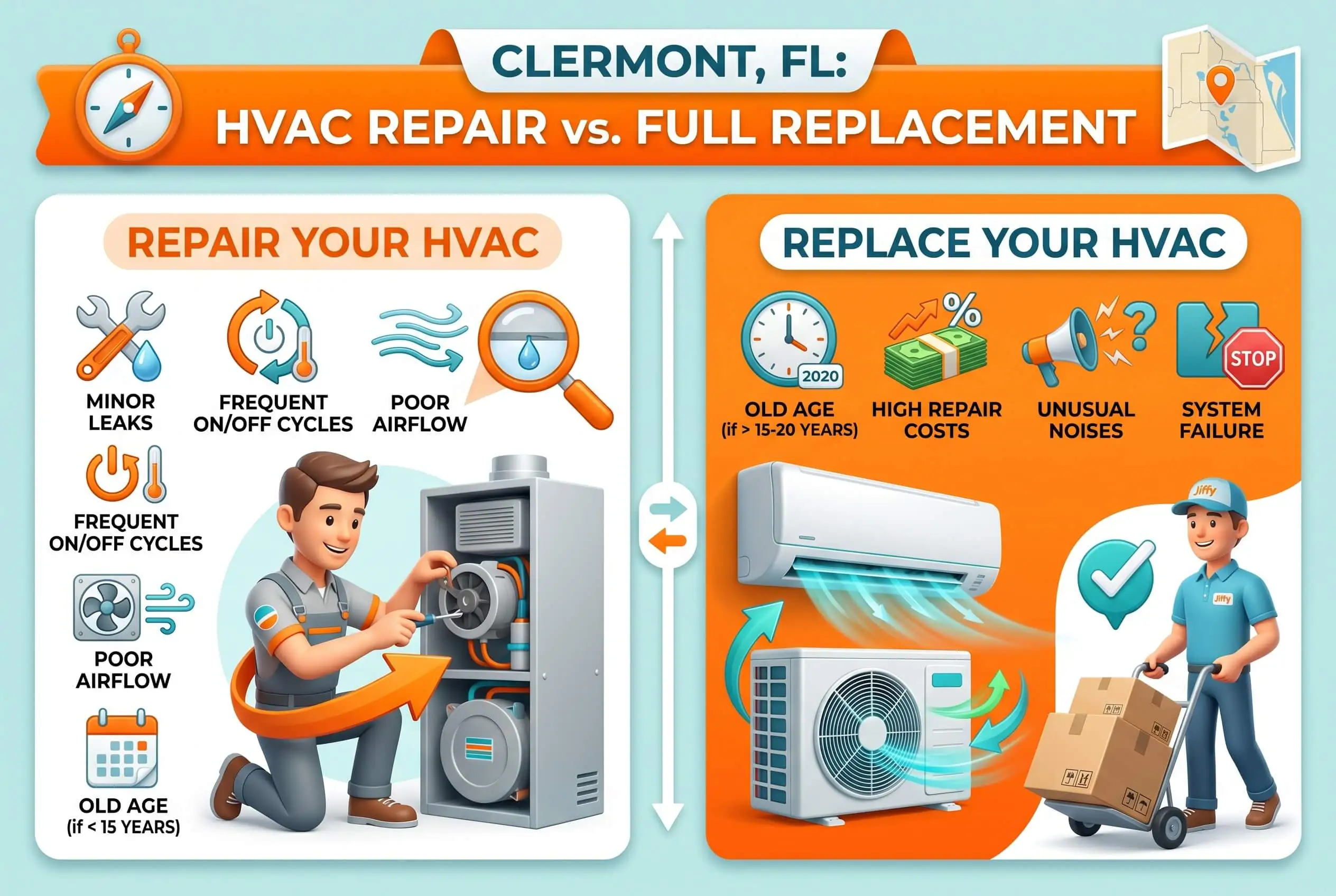
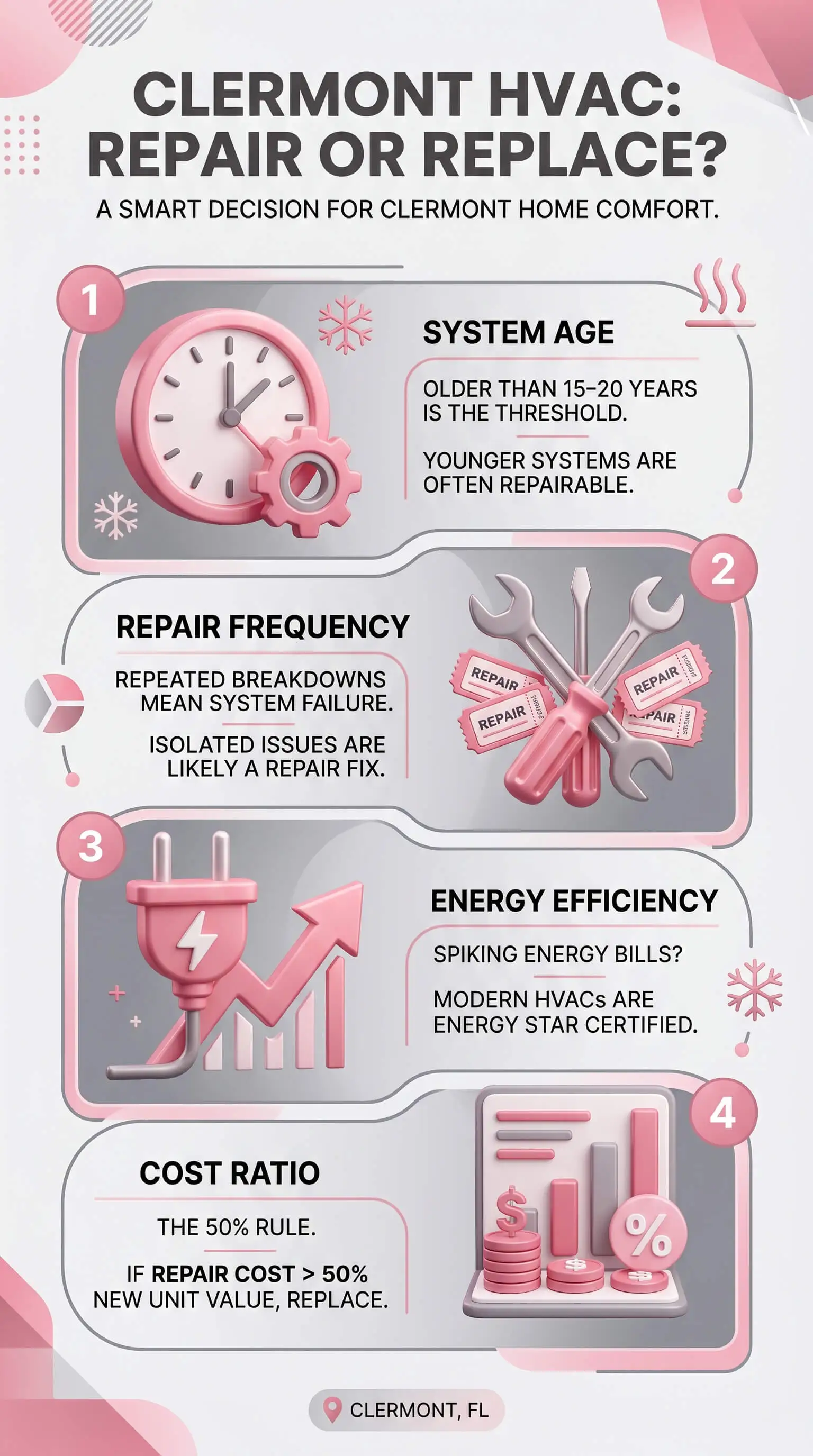
Your system is past its 12th Florida summer. Once equipment crosses that line, repair costs compound faster than the value of keeping the unit alive. The last few seasons of a Florida HVAC system's life are almost always the most expensive.
The repair-cost-times-age math fails the AHRI 5,000 rule. Multiply your quoted repair cost by the system's age in years. If the result exceeds 5,000, replacement usually wins on lifecycle cost.
The system still runs R-22 refrigerant. R-22 has been out of production since January 2020. Reclaimed supply is expensive and shrinking, and a leak repair on an R-22 system stops making financial sense fast.
Your Duke Energy bill keeps climbing without lifestyle change. Steadily rising summer bills with no added square footage, occupants, or new appliances usually means efficiency loss in the system itself.
Some rooms never cool, even with the unit running constantly. Persistent hot rooms typically point to undersized equipment, duct leakage, or refrigerant charge issues that compound with age.
Three or more emergency service calls in a single cooling season. A pattern of breakdowns is the system telling you what the diagnostic gauge can't quite confirm yet.
Water, ice, or refrigerant where it doesn't belong. Pooling water at the air handler, ice on the evaporator coil, or oily residue at the line set points to a refrigerant leak or a coil failure, both of which run expensive on older equipment.
When Repair Is Still the Right Call
We don't push replacement when repair is the better answer. Systems under 8 years old with active manufacturer warranties almost always come out ahead with targeted repair. A blown capacitor, a failed contactor, a stuck blower motor, a dirty condenser coil. All routine fixes that the best HVAC company will handle efficiently on healthy systems. We've kept 6-year-old American Standard and Trane systems in Heritage Hills and Magnolia Park running another decade with a single major component swap. SEER2 systems installed in 2023 are particularly worth saving. They already meet current efficiency standards, so replacement buys you reliability rather than energy savings.
The exception is a refrigerant leak in a system under warranty. Florida's high humidity makes coil leaks expensive to chase, and warranty replacement is often the cleaner path than three rounds of leak hunting in a humid attic.
How Clermont's Housing Eras Change the Decision
Three building periods dominate Clermont's older 34711 neighborhoods and the newer 34714 master-planned communities, and each one changes the math.
Historic Downtown Clermont (pre-1970, around Lake Minneola and Eighth Street). These homes were retrofitted for central air decades after they were built. Returns are undersized, plenums are improvised, and the system fights the architecture every cycle. When the equipment fails on a home like this, we usually recommend a full system plus ductwork redesign rather than a one-for-one swap.
1980s–90s mid-county subdivisions (off Hancock Road, the Greater Hills area, the SR-50 corridor). These are the houses where the original flex duct in the attic is the failure point we see most often. The equipment may be sound, but the duct system is leaking 25–35% of conditioned air into the attic insulation. Replacement decisions on these homes have to account for ductwork at the same time.
2000s and newer master-planned communities (Kings Ridge, Heritage Hills, Magnolia Park, Highland Ranch, Summit Greens). Code-compliant ductwork, zoned systems, and tighter envelopes mean repair often stays viable through year 12. When these homes do need replacement, the swap is straightforward and the upgrade to higher SEER2 ratings tends to pay back quickly.
Whichever era your home falls in, the decision should rest on diagnostic data rather than pressure. A professional HVAC replacement service in Clermont starts with a Manual J load calculation and a duct test before anyone quotes a price.
“In the 1980s and early '90s subdivisions off Hancock Road, the failure point we see most often isn’t the condenser — it’s the original flex duct in the attic. The system can be sound, but the ductwork is leaking 25–35% of conditioned air into the insulation. When a homeowner is deciding between a $2,800 compressor repair and a full system replacement, we ask whether the duct system is going to be replaced at the same time. If it isn’t, the new equipment will be fighting the same airflow problem the old one died from. That’s the conversation that actually saves homeowners money over the next ten years.”
Essential Resources
Every link below was verified live before publication. We rely on these primary sources when we're advising Clermont homeowners through the repair-versus-replacement decision.
U.S. Department of Energy — Central Air Conditioning — Official guidance on system sizing, SEER ratings, ENERGY STAR certification, and proper installation requirements including ACCA Manual J load calculation.
ENERGY STAR — Replace Your Central AC With a Heat Pump — Federal program guidance on whether to upgrade to a heat pump rather than another central AC, with savings estimates over the product lifecycle.
EPA Section 608 — Refrigerant Management Regulations — Current federal rules on refrigerant handling, R-22 phase-out, and certification requirements for any technician servicing your system.
Florida DBPR — MyFloridaLicense Verification Portal — Official Florida Department of Business and Professional Regulation tool for verifying any contractor’s license status, name, and disciplinary history.
Florida DBPR — Construction Industry Licensing — Details on Florida’s certified mechanical contractor (CAC) licensing standards, continuing education, and renewal requirements that legitimate HVAC contractors must meet.
Lake County, FL — Office of Building Services — Local permitting authority for HVAC installations and replacements in unincorporated Lake County, including the residential permit process for system swaps.
Wikipedia — Heating, Ventilation, and Air Conditioning — General reference covering the broader category of heating, ventilation, and air conditioning systems, including history, components, and standards.
Supporting Statistics
Each statistic below comes from a verified primary source. We cite these when we're explaining the cost case for replacement versus continued repair on aging Clermont systems.
Heating and cooling typically account for about 29% of a home's utility bill, making it the single largest energy expense in most households. Efficiency upgrades on aging equipment produce the largest dollar return there. (U.S. Department of Energy)
Replacing an older central AC with an ENERGY STAR certified heat pump can save approximately $600 over the life of the product on cooling costs alone, with additional winter savings stacked on top. That matters in a Lake County climate that runs cooling eight to nine months a year. (ENERGY STAR (EPA))
Effective January 1, 2025, residential split-system central air conditioners must meet SEER2 ≥ 17.0 and EER2 ≥ 12.0 to qualify for the federal Energy Efficient Home Improvement Tax Credit. That threshold matters for Clermont homeowners weighing a like-for-like replacement against an efficiency upgrade. (ENERGY STAR Federal Tax Credits)
Final Thoughts and Opinion
We approach this decision the same way we'd approach it in our own homes. If a system is past its 12th Florida summer and a major component fails, an HVAC replacement service is usually the responsible call. We've watched too many Clermont homeowners spend thousands of dollars repeatedly on a system that should have been retired after the first failure. If the system is younger, the failure is isolated, and the ductwork is sound, repair gets you another five to seven years of dependable service. The question we'd ask in your kitchen is the same one we ask in ours: is this fix going to outlast the next failure, or are we just pushing the bill down the road?
Frequently Asked Questions
Q: How long do HVAC systems last in Clermont's climate?
A: Twelve to fifteen years on average for systems installed in Lake County. The national 15–20 year figure assumes seasonal use; here, the system runs nearly year-round, and summer attic conditions shorten compressor and capacitor life. Older systems in the 1980s–90s subdivisions off Hancock Road sometimes reach 17–18 years, but those are usually limping by year 14.
Q: What's the average cost of HVAC replacement in Clermont?
A: Replacement cost varies by system size, efficiency tier, ductwork condition, and any electrical upgrades the home needs. We don't publish a flat rate because the load calculation changes the answer significantly. We offer free in-home estimates with no obligation.
Q: How do I check if my Clermont HVAC contractor is licensed?
A: Florida requires a CAC (Certified Air Conditioning) license issued by the DBPR for any HVAC contractor working statewide. You can verify any contractor in seconds at MyFloridaLicense.com by name or license number. Confirm the license is active, the license type starts with CAC, and there's no disciplinary history. Lake County also issues local registrations, so confirm both if the contractor only works regionally.
Q: Does my Clermont home need a new system if it has R-22 refrigerant?
A: Not automatically, but the math gets harder every year. R-22 has been out of production since January 2020, and the only available supply is reclaimed. A leak repair on an R-22 system can run several hundred dollars in refrigerant alone before labor. Most R-22 systems we see are also old enough that the compressor is the next thing to go. We typically recommend replacement when an R-22 system fails a leak test.
Q: Will replacing my HVAC lower my Duke Energy bill?
A: Usually yes, but the size of the drop depends on what you're replacing. A 14 SEER system from 2008 swapped for a 17 SEER2 system in 2026 typically reduces cooling-related electricity use by 20–30%. Houses in Heritage Hills and Magnolia Park with leaky ductwork often see less savings than the equipment rating suggests, because the ducts are still bleeding conditioned air into the attic.
Q: Should I replace ductwork at the same time as the HVAC system?
A: For homes built in the 1980s and early 1990s, almost always. We routinely test those duct systems at 25–35% leakage, well above the Florida code threshold for new construction. Replacing the equipment without addressing the ductwork forces a brand-new system to compensate for the same air loss the old one was fighting. For 2000s+ master-planned homes with code-compliant ductwork, a sealing pass is usually enough.
Q: What SEER2 rating makes sense for a Clermont home?
A: The federal minimum for new systems in Florida is 15 SEER2. We typically recommend 16–18 SEER2 for Clermont homeowners. The upgrade pays back faster here than in cooler climates because the cooling season runs eight to nine months. Above 18 SEER2 the equipment cost climbs faster than the energy savings unless the home runs cooling significantly more than average.
Find the Right Path for Your HVAC
If your system is showing two or more of the warning signs we've covered, the next step is a free in-home assessment. We'll run a Manual J load calculation, test your ductwork, check the refrigerant type, and give you the honest answer on whether repair still makes sense. Schedule a replacement consultation. We live here too, and we treat every estimate the way we'd want one done at our own house.
When deciding whether your HVAC system needs a simple repair or a full replacement, airflow efficiency and indoor air quality are two critical factors homeowners in Florida should never overlook. In our guide, How to Tell If Your Clermont HVAC Needs Repair or Full Replacement, we explain how clogged or outdated air filters can strain your system, increase energy bills, and shorten equipment lifespan. Replacing filters regularly with options like 20x20x2 HVAC air filters, 15x20x1 MERV 8 furnace filters, or pleated AC replacement filters can help improve system performance and may even delay the need for a costly HVAC replacement. Choosing high-quality filters is one of the simplest preventative maintenance steps homeowners can take to protect their comfort and extend the life of their heating and cooling system.