What happens after that is what most homeowners never trace back to the installation. Undersized returns. Disconnected duct joints. Filter housings that weren’t sealed at the air handler. None of it shows once drywall goes back up, but each one shapes whether the air in your home is filtered, dehumidified, and clean — or simply moved from room to room.
If you’ve been looking into top HVAC system installation near Winter Park FL, this is the conversation your contractor should already be having with you. Here’s what’s actually at stake.
TL;DR Quick Answers
What is the top HVAC system installation near Winter Park, FL?
The top HVAC system installation near Winter Park, FL starts with the right assessment — not just an equipment swap. Here's what separates a quality installation from a fast one:
A Manual J load calculation that sizes the system to your actual home, not a rule-of-thumb replacement
A duct assessment before the new system connects, covering joints, return air sizing, and supply path integrity
A post-installation review of filter housing, airflow, refrigerant charge, and thermostat calibration
An honest conversation about filter MERV selection and air quality before the job starts
Most Winter Park homes were built between the 1960s and 1990s. That original ductwork was sized for older, less efficient systems. Connecting a modern unit to aging, undersized infrastructure without assessing what's already there produces uneven cooling, elevated humidity, and a filtration path that doesn't perform as designed.
When evaluating HVAC installation companies, ask whether they perform a load calculation, inspect existing ductwork, and discuss indoor air quality before the first component is touched. If those aren't part of the conversation, keep looking.
Top Takeaways
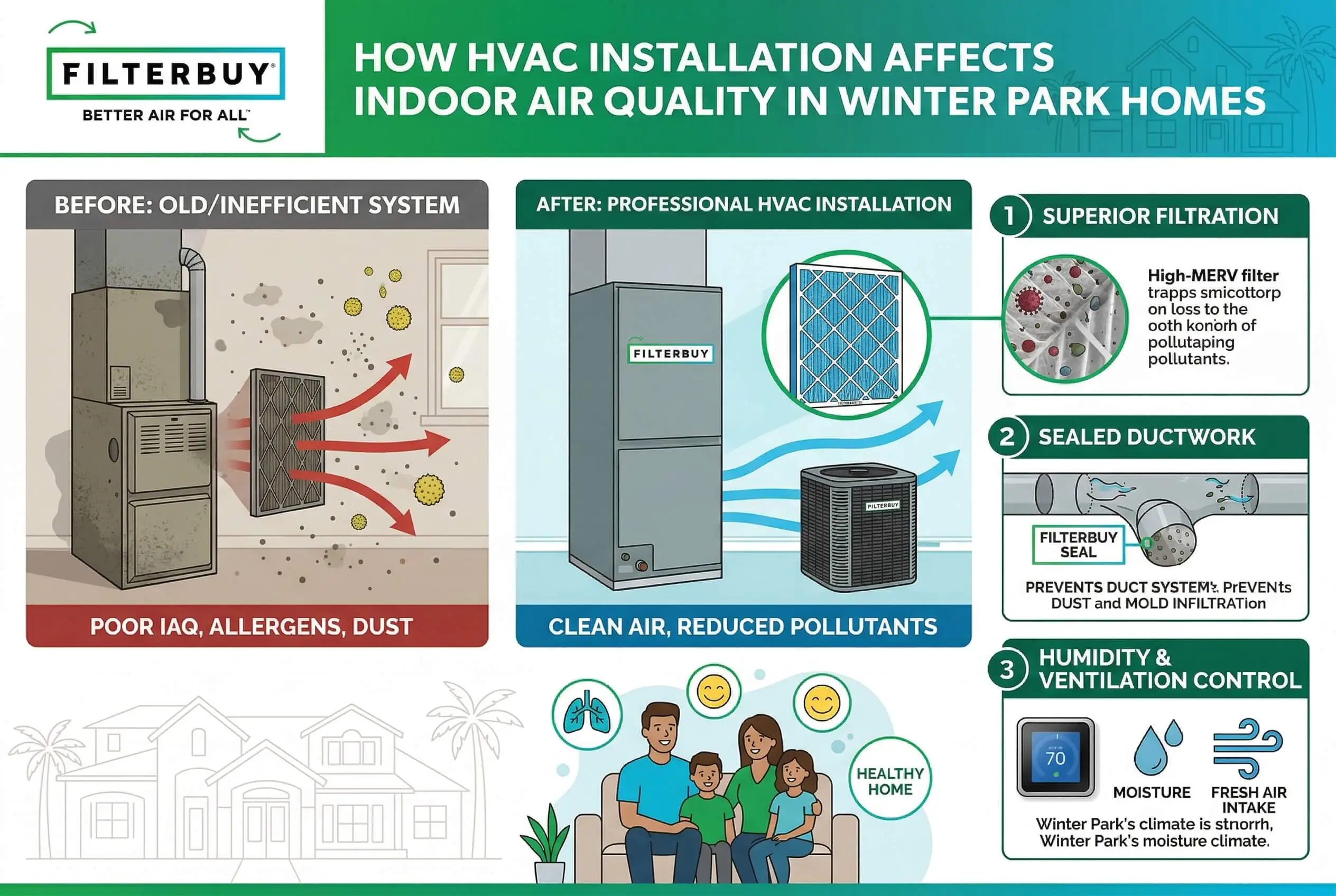
HVAC installation directly shapes indoor air quality, not just comfort or energy efficiency. The quality of the installation determines whether your system actually filters air or moves it around.
System sizing matters more than brand. An oversized unit short-cycles and leaves humidity in the air. In Winter Park’s subtropical climate, that humidity is the indoor air quality problem most homeowners never trace back to installation.
Duct condition at installation determines long-term performance. ENERGY STAR reports that up to 30 percent of conditioned air is lost to leaky ducts in a typical home. In Winter Park homes with older duct infrastructure, an installation that ignores the existing ductwork is already partially compromised.
Winter Park’s year-round AC demand and seasonal pollen load make installation quality a health consideration, not just a mechanical one. The HVAC system is the home’s primary indoor air defense.
A quality installation starts with a load calculation, includes a duct assessment, and ends with a conversation about filter selection and air quality. If those elements aren’t part of the plan, ask for them.
How a New HVAC Installation Shapes Your Home’s Air Quality
When a system is sized correctly, it runs in long cycles that pull humidity out of the air before it returns to your living space. That dehumidification is the quiet second job of your heating, ventilation, and air conditioning system, and in Central Florida it matters more than almost any other performance variable. An oversized system short-cycles: it reaches the set temperature before completing a full dehumidification pass, then shuts down while moisture stays behind.
That moisture doesn’t just settle on surfaces. Over time, it creates the conditions that mold and dust mite populations thrive in. For households with someone managing asthma or seasonal allergies, those conditions produce symptoms that are easy to attribute to something else entirely.
Ductwork carries its own set of consequences. How a technician connects, seals, and balances the duct system during installation determines whether filtered air actually reaches your rooms or bleeds into the attic before it gets there. We routinely find duct joints at Winter Park homes that were never properly sealed at installation. Homeowners only discover the problem when rooms won’t cool down, bills don’t match the thermostat, or dust comes back within days of cleaning.
Why Winter Park Homes Face Specific Challenges
Winter Park sits in the heart of Orange County, where homes run their HVAC systems year-round under subtropical heat and humidity. That constant demand accelerates wear on anything improperly installed or undersized from the start. A system built for seasonal use and a system running ten to twelve months a year are different problems entirely.
Homebuilders put up much of Winter Park’s housing stock between the 1960s and the 1990s. That original ductwork was sized for systems with different efficiency profiles than what we install today. Connect a modern high-efficiency unit to old, undersized duct infrastructure without assessing what’s already there, and the new system works against itself. Uneven cooling, elevated humidity in specific rooms, and a filtration path that doesn’t function as designed are the typical result.
Central Florida’s pollen seasons raise the stakes further. Oak, pine, and grass pollens circulate through much of the year. For households managing seasonal allergies, the HVAC system is the home’s primary indoor defense. A properly installed system with the right filter draws consistently and captures what comes through the return air. A system installed without attention to return air sizing and filter access does considerably less — and nobody explains to the homeowner why.
What Sets a Quality Installation Apart
A quality HVAC installation starts before a single component is disconnected. It starts with a Manual J load calculation: a formal assessment of your home’s square footage, ceiling heights, insulation levels, window count, and sun orientation. That calculation determines the correct system size for your specific home. Not a rule-of-thumb swap. Not same-size-for-same-size.
From there, your technician inspects the duct system. Are the existing joints still tight? Are there disconnected sections pulling attic air into the supply path? Are the return ducts large enough to feed the new system enough airflow? These questions don’t always get asked at a standard installation call, but they determine whether hvac when the new system goes in or stays exactly where it was.
The filter housing and return air pathway are the details that separate a thorough installation from a fast one. A system installed without confirmed filter access is one you can’t properly maintain. A system you can’t maintain loses its air quality benefit with every month that passes.
Signs Your Current System May Be Working Against Your Air
Most homeowners never connect their HVAC installation quality to the air quality problems they’re already living with. These are the signals worth watching:
Uneven cooling between rooms despite consistent thermostat settings
Dust accumulating faster than expected between filter changes
Musty or stale odors when the system kicks on, especially in the first few minutes of a cycle
Condensation on windows, moisture near registers, or damp spots along walls
Family members with more respiratory or allergy symptoms at home than elsewhere
Energy bills higher than expected with no change in thermostat habits
A system 12 to 15 years or older, at which point an assessment of both the unit and the ductwork is worth scheduling before the next cooling season
“In Winter Park, I see the same pattern over and over — a homeowner puts in a new system expecting their air quality problems to disappear, but the ductwork that came with the house is still leaking conditioned air into the attic. The installation is only as good as the system it connects to.”
7 Essential Resources
The resources below offer additional depth on HVAC systems, indoor air quality, and the health and performance factors most relevant to Central Florida homeowners. Each link has been confirmed live.
What Is an HVAC System and Why Installation Quality Matters
The mechanics of heating, ventilation, and air conditioning go well beyond thermostat settings and monthly bills. Understanding how these systems work and what good installation looks like gives homeowners the right questions to ask before any work begins.
Source: heating, ventilation, and air conditioning — Wikipedia
HVAC System Installation Services in Winter Park, FL
Filterbuy HVAC Solutions serves Winter Park and the surrounding Orange County area with HVAC installations built around your home’s specific needs, including duct assessment, proper system sizing, and an honest air quality conversation before the job starts.
Source: HVAC System Installation — Filterbuy HVAC Solutions, Winter Park FL
Introduction to Indoor Air Quality — U.S. Environmental Protection Agency
The EPA’s foundational resource on what creates indoor air quality problems, why inadequate ventilation amplifies them, and what the three main strategies for improving indoor air look like in practice. Worth reading for any homeowner whose home hasn’t had an HVAC assessment in years.
Source: Introduction to Indoor Air Quality — U.S. EPA
How to Improve Indoor Air Quality — U.S. Environmental Protection Agency
Source control, ventilation, and filtration: the EPA breaks down what actually works for homeowners looking to reduce pollutant levels indoors. Includes specific guidance on how HVAC systems interact with ventilation to bring outdoor air into your living space or keep contaminants out of it.
Source: Improving Indoor Air Quality — U.S. EPA
Duct Sealing and Its Impact on Energy and Air Quality — ENERGY STAR
ENERGY STAR’s duct sealing resource explains what happens to conditioned air in a typical home and why leaky ducts translate directly into higher energy bills and worse indoor air quality. If your ductwork has never been evaluated, this is the clearest explanation of why that matters.
Source: Duct Sealing — ENERGY STAR
Why Indoor Air Quality Matters — U.S. Environmental Protection Agency
EPA research on how indoor air quality affects health across all age groups, with particular attention to why children, elderly adults, and people managing respiratory conditions face greater exposure to indoor pollution sources. The data on time spent indoors puts the stakes in plain terms.
Source: Why Indoor Air Quality Is Important — U.S. EPA
National Asthma Data — Centers for Disease Control and Prevention
The CDC’s national asthma surveillance data, including prevalence rates by age, geography, and demographic group. For households with members managing asthma, the connection between indoor air quality and trigger reduction makes installation quality a direct health consideration.
Source: Most Recent Asthma Data — CDC
These seven essential resources highlight the value of top HVAC system installation by showing how the right system design, proper ductwork, effective ventilation, and strong indoor air quality practices can help Central Florida homeowners enjoy greater comfort, healthier air, better efficiency, and more confidence in every installation decision made in Winter Park.
Supporting Statistics
The EPA reports that indoor air can be two to five times more polluted than outdoor air, and in some cases the gap exceeds 100 times the outdoor level. Americans spend about 90 percent of their time indoors. For Winter Park homeowners running HVAC systems year-round, indoor air quality isn’t a seasonal question.
After manufacturing filters for over a decade and serving more than two million households, this is the number that consistently surprises people the most.
Source: https://www.epa.gov/iaq-schools/why-indoor-air-quality-important-schools
ENERGY STAR reports that in a typical home, 20 to 30 percent of the air moving through the duct system is lost to leaks, holes, and poorly connected joints. That means up to three in ten units of conditioned and filtered air your system produces never reach your living space, while the system works harder and runs longer to compensate.
In homes across Central Florida where we’ve inspected existing ductwork before installation, this is more common than not.
Source: https://www.energystar.gov/saveathome/heating-cooling/duct-sealing
The CDC reports that approximately 25 million Americans currently have asthma. Indoor air quality ranks among the most significant environmental triggers for the condition. In homes where installation left ducts leaking or return air pathways undersized, the system that should reduce indoor triggers may be doing very little about them.
Source: https://www.cdc.gov/asthma-data/about/most-recent-asthma-data.html
Final Thought & Opinion
Here’s what we’ve learned from working in Winter Park homes: the conversation about what an installation does to your home’s air almost never happens at the sales call. It almost never comes from a contractor whose focus is moving on to the next job.
That doesn’t make your neighbors’ experiences unusual. It makes them standard. Most homeowners find out an installation wasn’t done right the way homeowners always find out — through a problem they can’t immediately explain. Higher bills. A room that won’t cool. A family member whose symptoms improved everywhere but home.
The connection between installation quality and indoor air quality is fixable. It starts with better questions before any new system goes in: about load calculations, duct condition, filter access, and what the installation team plans to evaluate beyond the mechanical swap itself.
You shouldn’t have to ask for that conversation. It should come with the job. At Filterbuy HVAC Solutions, it does.
Frequently Asked Questions
Q: How does HVAC installation affect indoor air quality in Winter Park homes?
A:
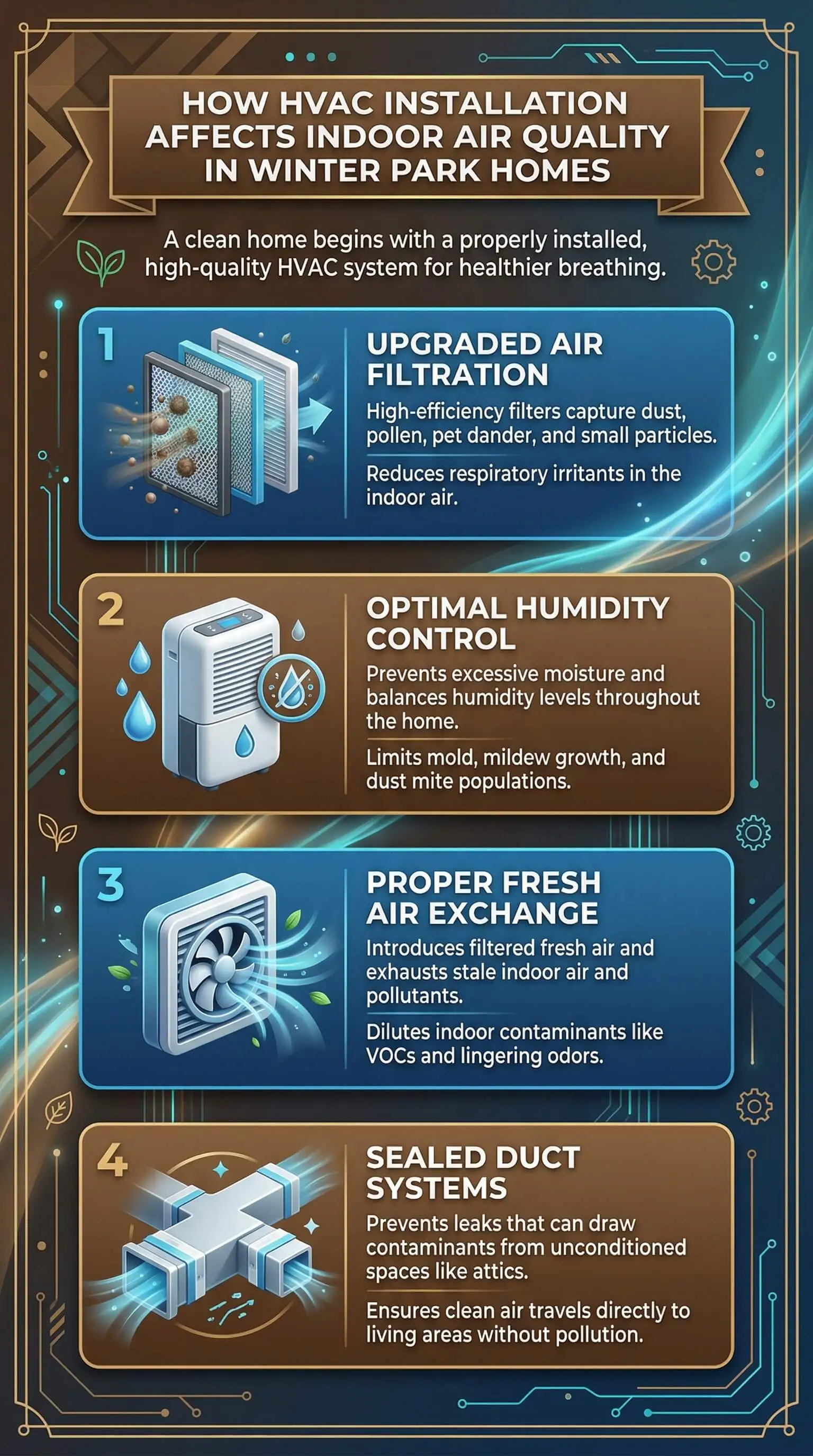
Installation quality determines system sizing, duct integrity, and filter path function. Those three factors together control whether the air in your home is dehumidified, filtered, and clean.
An oversized system short-cycles, skipping the dehumidification pass that removes moisture from the air. A poorly sealed duct system draws unfiltered air from attic and crawlspace areas into the supply path.
The installation is the foundation. Filter performance, humidity management, and allergen reduction all depend on how well your technician built that foundation.
Q: What should I look for in a top HVAC system installation near Winter Park, FL?
A:
A licensed technician who starts with a Manual J load calculation, not a same-size replacement assumption.
A duct assessment before the new system is connected, covering joints, return air sizing, and supply path integrity.
Filter housing review and confirmation of adequate return air flow.
Post-installation testing for airflow, refrigerant charge, and thermostat calibration.
A direct conversation about filter MERV selection, change frequency for Central Florida conditions, and whether any humidity or air quality products make sense for your specific home.
Q: How much does HVAC installation cost in Winter Park, Florida?
A:
Most residential HVAC installations in Winter Park range between $5,000 and $12,000, depending on system type, home size, and whether the existing ductwork requires modification.
The most reliable number comes from an in-home estimate. Layout, load, and duct condition all affect the final cost in ways no online calculator can account for.
Filterbuy HVAC Solutions offers free in-home estimates for Winter Park homeowners.
Q: How long does HVAC installation take in Winter Park?
A:
A standard residential HVAC replacement typically takes one full day.
Installations that include duct repairs, return air modifications, or other infrastructure work may take two to three days.
A thorough installation team gives you a realistic timeline at the estimated stage, not after the job has started.
Q: What MERV rating filter should I use after a new HVAC installation in Florida?
A:
MERV 11 is the right starting point for most Winter Park homes. It captures dust, pollen, mold spores, and pet dander without restricting airflow in systems not built for higher-rated filters.
MERV 13 is worth considering during peak pollen season or when wildfire smoke is affecting Central Florida air quality. Confirm with your installation technician that your system can accommodate it.
Change filters every 30 to 90 days depending on household conditions. Pets, occupancy, and outdoor pollen levels all affect how quickly a filter loads.
Q: Will a new HVAC installation reduce allergens in my Winter Park home?
A:
It can, but only if the installation is done correctly. A properly sized system running full cycles dehumidifies the air and reduces conditions that allow mold and dust mite populations to grow.
Properly sealed ducts ensure that what passes through your filter is the air from your living space, not drawn from unconditioned areas.
Filter selection and change schedule matter as much as the installation itself. A MERV 11 filter on schedule in a well-installed system outperforms any filter in a system installed without attention to these factors.
Q: Does Filterbuy HVAC Solutions serve Winter Park, FL for HVAC installation?
A:
Yes. Filterbuy HVAC Solutions serves Winter Park and the surrounding Orange County area for residential HVAC installations, replacements, and related air quality services.
Our team brings the same approach to every job: a proper load assessment, an honest review of the existing ductwork, and a focus on what the installation means for your home’s air, not just its temperature.
We live and work in this community. We understand the seasonal pressures Florida homes face, and we’re here when you need us.
Ready to find out what your installation could mean for your home’s air?
If your home is due for a new system, or if you’ve been living with comfort or air quality problems you’ve never been able to trace to a source, we’d be glad to take a look.
Our team serves Winter Park and the surrounding Orange County area. We’ll walk you through exactly what we find: an honest assessment of your system, your ductwork, and what an installation built around your home’s actual needs could mean for the air your family breathes.
No pressure. Just a real conversation from neighbors who happen to know a lot about HVAC.
Schedule your free in-home estimate.