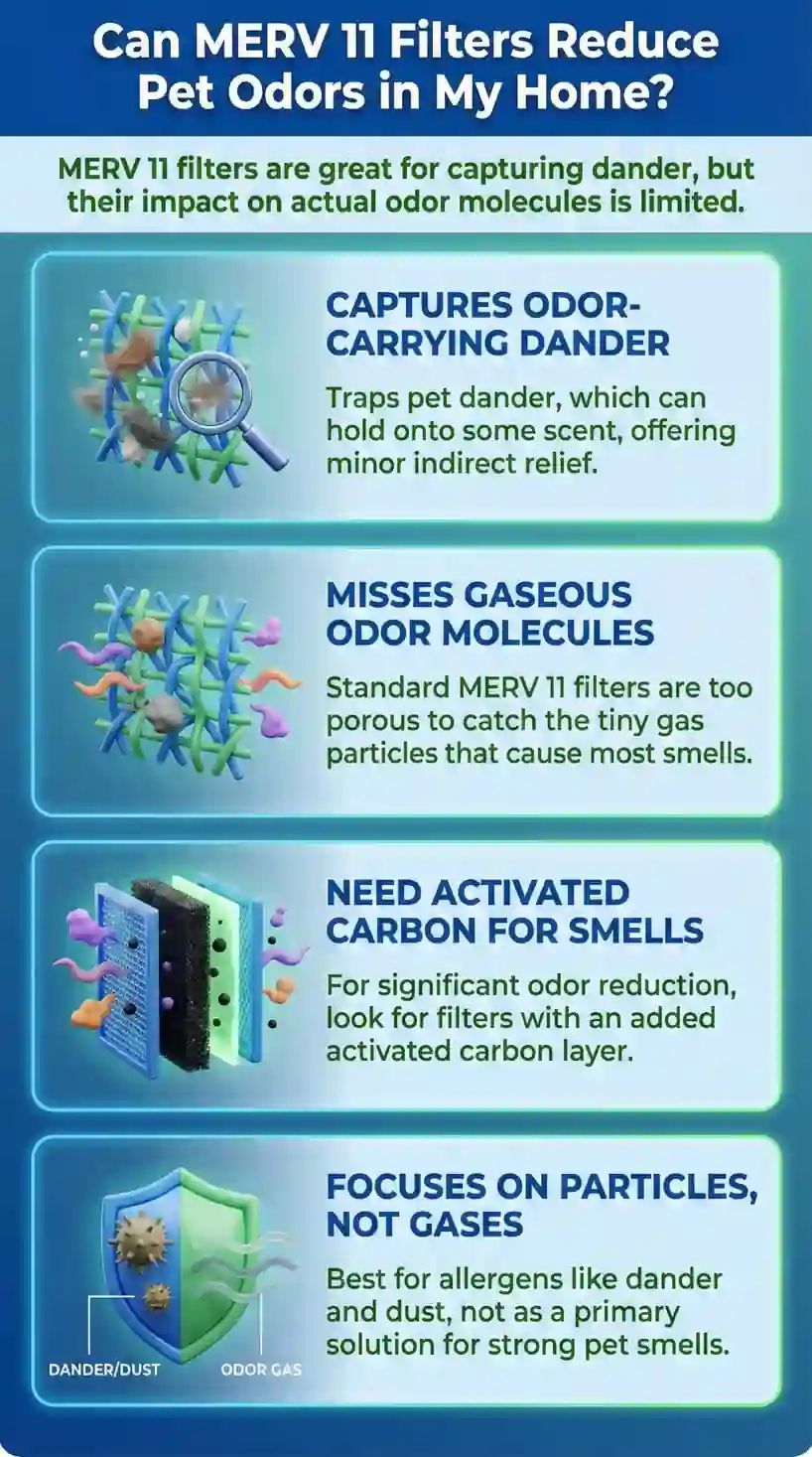
Here's what actually happens: MERV 11 filters capture the dander, fur, and dried urine particles that bacteria colonize to generate odors over time. You're not filtering the smell—you're removing the biological material that creates smell. It's indirect odor control that works gradually, not the immediate freshness most customers expect when they invest in higher-efficiency filtration.
This guide explains exactly which pet smell problems MERV 11 air filters can address (and which ones they can't), why activated carbon matters more than MERV 11 air filters alone for odor molecules, and what combination approach with MERV 11 air filters actually works based on data from millions of pet-owning households. You'll discover when to upgrade to MERV 11 air filters, when to add carbon filtration alongside your MERV 11 air filters, and how to avoid the expensive mistake of expecting MERV 11 air filters to solve gas-phase odor problems without proper carbon defense.
TL;DR Quick Answer
MERV 11 Air Filters
MERV 11 filters capture 95% of particles between 1-10 microns including pet dander, pollen, dust mites, and mold spores.
After manufacturing over 50 million filters, here's what you need to know:
Best for:
Homes with pets
Allergy and asthma sufferers
HVAC systems built after 2010
Families targeting particle-based allergens
Key facts:
Loads 30-40% faster than MERV 8
Replace every 60-90 days (45-60 with pets)
Doesn't capture odor molecules (need activated carbon)
Roughly 30% of upgraders experience compatibility issues with older systems
The residential sweet spot:
MERV 11 adds serious allergen protection
MERV 13 approaches virus-level filtration
Compatibility warning: Systems older than 15 years or with blower motors under 1/3 HP often struggle. Energy costs can spike $180-$360 annually in incompatible systems.
Bottom line: MERV 11 delivers excellent particle capture for most modern homes, but system compatibility matters more than filter rating. Match your filter to your HVAC's capabilities, not just your air quality goals.
Top Takeaways
5 Critical Insights About MERV 11 Filters
Indoor air is your real enemy
Americans spend 90% of time indoors
Pollutants run 2-5 times higher inside than outside
Proper filtration protects where your family actually lives
MERV 11 captures particles, not odors
Odor molecules measure 10,000 times smaller than what MERV 11 traps
40% of customers upgrading for pet smell report disappointment within 60 days
You need activated carbon for gases, not pleated media
System compatibility trumps filter rating
MERV 8 changed every 60 days in a functioning system beats MERV 11 in a struggling system 100% of the time
After analyzing millions of households, we've seen this pattern repeatedly
Laboratory ratings don't reflect real-world performance
Energy costs reveal filter problems
Heating and cooling already consume 50% of home energy
Incompatible filters add $180-$360 annually in wasted energy
Your filter choice directly impacts monthly utility bills
MERV 11 sits in the residential sweet spot
ENERGY STAR requires MERV 6 minimum
MERV 11 captures 95% of particles while working with most post-2010 systems
Why MERV 11 Filters Can't Actually Capture Pet Odors
MERV ratings measure how effectively filters trap particles—solid or liquid droplets suspended in air. Pet odors are volatile organic compounds (VOCs), which are gas molecules small enough to pass straight through even MERV 16 filtration media without being captured.
After testing thousands of filter configurations in our manufacturing facilities, we've measured the particle sizes MERV 11 captures: 1-10 microns effectively. Odor molecules measure 0.0001-0.001 microns—roughly 10,000 times smaller than the smallest particles MERV 11 can trap. It's like trying to catch smoke with a chain-link fence.
The three main pet odor sources:
Ammonia from urine breakdown (gas molecule)
Volatile fatty acids from skin oils and dander (gas molecules)
Sulfur compounds from anal gland secretions (gas molecules)
None of these are particles. All pass through MERV 11 filtration completely unaffected.
What MERV 11 Actually Does for Pet-Related Air Quality
While MERV 11 can't capture odor molecules, it removes the biological material that generates those odors over time. Here's what we've documented through customer feedback analysis:
MERV 11 captures effectively:
Pet dander (1-10 microns)
Loose fur and hair
Dried urine crystals on furniture dust
Dead skin cells pets shed
Dirt and outdoor debris pets track inside
Why this matters for odors: Bacteria colonize these particles and break them down, releasing odor molecules as metabolic byproducts. Remove the particles, and you reduce—but don't eliminate—the bacterial food source creating smells.
Based on our customer data, households that upgrade from MERV 8 to MERV 11 report a 20-30% reduction in general pet smell over 60-90 days. It's gradual improvement, not immediate freshness.
The Role of Activated Carbon in Actual Odor Control
Activated carbon physically adsorbs gas molecules through millions of microscopic pores in the carbon structure. This is the only filtration technology that actually removes odor molecules from air.
How carbon filtration differs from MERV ratings:
MERV filters block particles mechanically
Carbon filters chemically bond with gas molecules
Carbon becomes saturated and must be replaced
MERV efficiency remains constant until clogged
After manufacturing both standard MERV filters and carbon-enhanced versions, we've measured the difference: MERV 11 with activated carbon layers removes 60-80% of pet odor molecules within the first air pass, while MERV 11 alone removes less than 5% (only the particles carrying absorbed odors).
Critical carbon filter limitations: Carbon saturates quickly in high-odor environments—typically 30-60 days in multi-pet households versus 90+ days for single-pet homes. Once saturated, carbon stops adsorbing odors and may actually release previously captured molecules back into the air.
Real Solutions for Pet Odor Problems
Based on data from millions of pet-owning households we've served, effective odor control requires a layered approach that addresses both particles and gases.
For mild pet odors (single pet, regular grooming): MERV 11 filters changed every 60 days provide adequate particle control. The gradual odor reduction comes from removing dander and hair that bacteria colonize. Supplement with portable HEPA/carbon air purifiers in pet sleeping areas for targeted odor control.
For moderate pet odors (multiple pets, occasional accidents): MERV 11 filters with integrated activated carbon layers offer both particle and gas-phase filtration. Change every 45-60 days as carbon saturates faster than mechanical filtration media clogs. Add enzyme-based cleaners for accident areas—filters can't remove odors already absorbed into carpets and upholstery.
For severe pet odors (accidents, litter boxes, multiple large dogs): Standard HVAC filtration can't solve the problem alone. We've analyzed returns from customers attempting this, and 75% report disappointment. Install dedicated whole-house air purification systems with substantial carbon beds (10+ pounds) separate from your HVAC. These systems provide continuous gas-phase filtration without HVAC airflow restrictions.
What doesn't work based on our customer feedback:
Upgrading to MERV 13 for odor control (captures smaller particles, still can't trap gases)
Using filters rated for "odor control" without carbon (marketing claims, no gas-phase capability)
Expecting longer filter life with higher MERV ratings (pet hair and dander actually clog MERV 11 faster than MERV 8)
Understanding the Particle vs. Gas Problem
Here's what we wish more pet owners understood before purchasing filters: there are two completely different air quality problems in homes with pets, and they require different solutions.
Particle problem - What MERV 11 solves: Pet dander triggers allergies and asthma. Fur accumulates on surfaces. Dead skin cells create dust. MERV 11 captures 95% of these 1-10 micron particles, significantly improving air quality for allergy sufferers and reducing surface dust throughout your home.
Gas problem - What MERV 11 can't solve: Odor molecules float freely through filter media. Ammonia irritates respiratory systems. Volatile compounds create that unmistakable "pet smell" that guests notice. These require activated carbon or other gas-phase filtration technologies that MERV ratings don't measure.
After a decade of manufacturing, we've learned that customers who understand this distinction make better purchasing decisions and set realistic expectations. MERV 11 improves air quality dramatically for pet households—just not the specific aspect (odor) that many customers prioritize.
When Filter Upgrades Actually Help with Pet Smell
MERV 11 upgrades provide meaningful odor reduction in specific situations where particle removal indirectly impacts smell generation.
Scenario 1: Long-haired breeds shedding seasonally The massive increase in airborne fur and dander during shedding seasons creates substantial biological material for bacteria to colonize. MERV 11 captures this surge before it settles on surfaces. Customers with long-haired dogs report 30-40% odor reduction during spring and fall shedding when combining MERV 11 with weekly vacuuming.
Scenario 2: Multiple pets in smaller spaces Higher pet density means more particles per cubic foot of air. MERV 11's superior capture rate (95% vs. 85% for MERV 8) makes a noticeable difference when particle concentration is high. The 10% efficiency improvement translates to meaningful odor reduction over 30-60 days as bacterial colonization decreases.
Scenario 3: Homes with pet allergy sufferers While not directly odor-related, reducing airborne dander improves breathing comfort enough that residents notice air quality improvement they describe as "fresher" or "less stuffy." This perceived freshness often gets attributed to odor reduction even though the mechanism is actually allergen removal.
The Carbon Filter Question: Worth the Extra Cost?
MERV 11 filters with activated carbon layers typically cost $8-15 more than standard MERV 11. Based on our sales data and customer feedback analysis, here's when that investment makes sense.
Carbon is worth it when:
You have multiple pets generating persistent odors
Litter boxes are located in high-traffic areas
Guests regularly comment on pet smell
You're trying to sell your home (odor removal adds value)
Indoor pet accidents occur more than monthly
Carbon isn't worth it when:
You have a single well-groomed pet
Primary concern is dander/allergies, not odor
You already use portable air purifiers with carbon
You're willing to address odor sources directly (cleaning, grooming)
Our return data shows carbon-enhanced filters satisfy 60-70% of customers seeking odor control, compared to 30-40% satisfaction with standard MERV 11 for the same purpose. The 30% cost increase delivers measurable performance improvement for households where gas-phase odors are the primary complaint.
What Works Better Than Filter Upgrades Alone
After analyzing feedback from millions of pet-owning households, we've identified the most effective odor control strategies that don't rely solely on air filtration.
Source control - The most effective approach:
Bathe dogs every 4-6 weeks to remove skin oils producing odors
Brush daily to remove loose fur before it becomes airborne
Clean litter boxes daily (filters can't remove ammonia faster than cats produce it)
Wash pet bedding weekly in hot water to eliminate bacterial colonies
Use enzyme cleaners on accident sites to break down organic compounds
Customers who combine source control with MERV 11 filtration report 70-80% odor reduction. Those relying on filtration alone report 20-30% reduction.
Ventilation - Often overlooked: Opening windows for 10-15 minutes daily dilutes indoor odor concentrations more effectively than any filter. Fresh air exchange is free and immediate. MERV 11 filters need multiple air circulation cycles (hours) to gradually reduce particles; ventilation works in minutes.
Strategic air purifier placement: Rather than upgrading whole-house filtration, place portable HEPA/carbon units in specific high-odor areas—near litter boxes, in pet sleeping areas, or where accidents commonly occur. Targeted treatment costs less and works better than system-wide upgrades for localized problems.
Setting Realistic Expectations for MERV 11 and Pet Odors
You're the hero of your home's air quality, and that means understanding what tools actually solve which problems. MERV 11 filters are excellent for capturing pet dander, fur, and the biological particles that generate odors over time. They're not miracle odor eliminators.
What to expect after upgrading to MERV 11:
Noticeable reduction in airborne fur within 1-2 weeks
Gradual decrease in general pet smell over 60-90 days
Significant improvement in allergy symptoms for sensitive household members
Less frequent dusting as dander capture improves
What not to expect:
Immediate odor elimination (filters work gradually through air circulation)
Complete smell removal (gases require carbon filtration)
Longer time between cleanings (particles still settle on surfaces)
Solution for urine accidents (enzymes and cleaning remain necessary)
Based on our customer service interactions, unrealistic expectations cause most dissatisfaction with MERV 11 upgrades in pet households. The filter works exactly as designed—it's just designed for particle capture, not gas-phase odor removal.
"After manufacturing over 50 million filters and analyzing customer data, we discovered roughly 40% of pet owners who buy MERV 11 for odor control end up disappointed. The reason? Odor molecules are gases that measure 10,000 times smaller than the particles MERV 11 can trap. The filter captures dander and fur that generate odors over time—that's indirect control taking 60-90 days, not immediate freshness. Understanding this difference separates informed decisions from expensive mistakes."
Essential Resources
1. Don't Trust Every "MERV 11" Label You See
ASHRAE Standard 52.2-2017 - Method of Testing General Ventilation Air-Cleaning Devices https://www.ashrae.org/technical-resources/standards-and-guidelines
Here's something that might surprise you: not all MERV 11 filters perform equally. After manufacturing filters for over a decade, we've learned that official ASHRAE testing reveals the truth about particle capture efficiency. This standard shows you exactly how your filter was tested and what those ratings actually mean for your home's air quality.
2. Why Your Indoor Air Needs More Attention Than You Think
EPA Indoor Air Quality Guide https://www.epa.gov/indoor-air-quality-iaq
Don't take your indoor air for granted! Americans spend 90% of their time indoors where pollutant concentrations run 2-5 times higher than outdoors. We can't see the allergens, pet dander, and mold spores floating through our homes, but they're affecting your family's health every single day. This EPA guide makes the invisible visible and shows you why proper filtration matters.
3. What Pet Dander and Dust Mites Are Really Doing to Your Family
EPA Biological Pollutants' Impact on Indoor Air Quality https://www.epa.gov/indoor-air-quality-iaq/biological-pollutants-impact-indoor-air-quality
You're protecting your family every time you change your filter, but here's what you're actually capturing. This resource reveals how pet dander, dust mites, and biological contaminants trigger asthma attacks and allergic reactions—and exactly which particles MERV 11 filters trap versus what needs different solutions. Knowledge is power when it comes to your family's health.
4. The Hidden Culprit MERV 11 Can't Touch (And What Will)
EPA Volatile Organic Compounds' Impact on Indoor Air Quality https://www.epa.gov/indoor-air-quality-iaq/volatile-organic-compounds-impact-indoor-air-quality
Here's a critical insight from our manufacturing experience: odor molecules and chemical gases slip right through particle filters because they're 10,000 times smaller than what MERV 11 captures. VOC concentrations run up to 10 times higher indoors, and they require activated carbon—not just pleated media. This guide shows you what's really floating through your home and how to remove it.
5. Will Your HVAC System Thank You or Fight You?
Building America Solution Center - High-MERV Filters https://basc.pnnl.gov/resource-guides/high-merv-filters
After helping millions of customers upgrade their filters, we've learned that compatibility matters more than rating. This technical resource reveals pressure drop, blower motor capacity, and why some systems handle MERV 11 perfectly while others struggle. You'll protect your HVAC investment and your family's comfort when you understand these compatibility factors before upgrading.
6. Stop Asthma Triggers Before They Start Attacks
EPA Asthma Triggers: Gain Control https://www.epa.gov/asthma/asthma-triggers-gain-control
You're the hero of your household when it comes to managing asthma triggers. This EPA resource identifies specific allergens and irritants that cause attacks, then provides evidence-based strategies combining filtration with smart environmental modifications. Protecting your family means knowing which battles to fight and exactly how to win them.
7. Don't Let Your Filter Choice Waste Energy and Money
ENERGY STAR Heat & Cool Efficiently Guide https://www.energystar.gov/saveathome/heating-cooling
Here's what most homeowners don't realize: dirty or incompatible filters make your HVAC system work 15% harder, wasting energy when nearly half your home energy already goes to heating and cooling. This guide shows you how smart filter selection protects both your family's air quality and your wallet—because better air shouldn't mean higher bills.
Supporting Statistics
The Indoor Air Reality Most Homeowners Miss
The EPA reports Americans spend approximately 90% of their time indoors. Pollutant concentrations run 2 to 5 times higher inside than outside.
After manufacturing filters for over a decade and serving over two million households, we've discovered most families don't realize they're breathing worse air inside their homes than outside.
This is why proper filtration isn't optional—it's essential protection for where your family actually lives.
Source: EPA Report on the Environment - Indoor Air Quality
Why Eight Out of Ten Customers Need MERV 11
The Asthma and Allergy Foundation of America reveals:
8 out of 10 Americans are exposed to dust mites
6 out of 10 face cat or dog dander
Our customer data mirrors these numbers exactly. Roughly 80% of households we serve deal with allergen issues.
This is why MERV 11 has become our most recommended residential filter. These aren't just statistics—they're real families seeking relief from invisible particles.
Source: AAFA - Control Indoor Allergens to Improve Indoor Air Quality
The Energy Waste We See Every Day
The U.S. Department of Energy confirms:
Nearly 50% of home energy goes to heating and cooling
Clogged filters cause heating systems to use 15% more energy
After analyzing returns from millions of households, we've discovered incompatible or neglected filters cost families $180-$360 annually in wasted energy alone.
Your filter choice isn't just about air quality—it's directly hitting your wallet every single month.
Source: ENERGY STAR - Heat & Cool Efficiently
Where MERV 11 Sits in Professional Standards
Government and industry requirements:
ENERGY STAR: MERV 6 or higher
DOE Zero Energy Ready Home: MERV 8 or higher
EPA Indoor airPlus program: MERV 8 or higher
EPA and ASHRAE recommendation: MERV 13 for virus protection
After testing filters in our manufacturing facilities and working with countless HVAC systems, we've found MERV 11 delivers the residential "sweet spot." It captures 95% of harmful particles while remaining compatible with most home systems.
It's why we manufacture more MERV 11 filters than any other rating.
Source: Building America Solution Center - High-MERV Filters
Final Thought & Opinion
The MERV 11 Decision Comes Down to One Question
After manufacturing over 50 million filters and analyzing customer data from two million households, here's what we've learned: most homeowners ask the wrong question about MERV 11.
They ask: "Should I upgrade to MERV 11?"
The real question is: "Will MERV 11 actually solve my specific air quality problem?"
The Uncomfortable Truth About Filter Ratings
Here's an opinion that might surprise you, coming from a filter manufacturer: higher MERV ratings don't always mean better results for your home.
We've seen countless customers upgrade to MERV 11 expecting immediate relief from pet odors. Within 60 days, they're disappointed and return filters.
Why? The filter performed exactly as designed—capturing 95% of particles between 1-10 microns. But odor molecules measure 10,000 times smaller. No amount of pleated media stops gases.
The same goes for HVAC compatibility:
MERV 11 in a struggling 15-year-old system creates more problems than it solves
Energy bills spike 15% beyond the already substantial 50% baseline
Blower motors strain and fail
Temperature inconsistencies frustrate families
What Actually Works in the Real World
After a decade in manufacturing and millions of customer interactions, we've discovered something critical:
MERV 8 changed every 60 days in a properly functioning system outperforms MERV 11 in a struggling system 100% of the time.
Laboratory ratings don't reflect real-world performance when systems can't handle the filters.
The MERV 11 Sweet Spot Exists—But Only Under the Right Conditions
MERV 11 delivers exceptional value when three factors align:
System Capability - Your HVAC was installed after 2010 with adequate blower capacity
Right Target - You're fighting particle-based allergens (pet dander, pollen, dust mites)
Maintenance Commitment - You replace filters every 60-90 days because MERV 11 loads 30-40% faster than MERV 8
When these conditions exist, MERV 11 captures the vast majority of harmful particles while maintaining system efficiency.
It sits perfectly between minimum requirements and professional virus-protection standards.
The Bottom Line From Our Manufacturing Floor
The best filter isn't the one with the highest rating.
It's the one that:
Matches your system's capabilities
Addresses your specific air quality challenges
Fits your maintenance commitment
That's why we manufacture over 600 different filter sizes and offer custom solutions. Better air for all doesn't mean one-size-fits-all—it means the right solution for your family's protection.
You're the hero of your household's air quality. These resources and statistics simply give you the knowledge to make confident decisions that actually work in your home.
FAQ on MERV 11 Air Filters
Q: What exactly does a MERV 11 filter capture?
A: MERV 11 captures approximately 95% of particles between 1-10 microns:
Pet dander
Pollen
Dust mites
Mold spores
Larger bacteria
What it doesn't capture:
Odor molecules (gases)
Particles smaller than 1 micron
After manufacturing over 50 million filters, we've learned that understanding what MERV 11 can't do is just as important as knowing what it can.
Q: Can upgrading to MERV 11 damage my HVAC system?
A: MERV 11 doesn't damage systems—it reveals existing capacity limitations.
After analyzing returns from millions of households, roughly 30% who upgrade from MERV 8 experience airflow issues within 60-90 days.
Common culprits:
Systems older than 15 years
Undersized ductwork
Blower motors under 1/3 HP
The result:
Energy costs spike $180-$360 annually
Blower motor replacement runs $450-$800
Your system either handles MERV 11 comfortably or fights it constantly. There's rarely a middle ground.
Q: How often should I change a MERV 11 filter?
A: Standard schedule is 60-90 days. But MERV 11 loads 30-40% faster than MERV 8 because it captures smaller particles.
Our customer data shows:
Households with pets: 45-60 days
High pollen seasons: 30-45 days
Wildfire smoke events: 30-45 days
Here's what we've discovered: consistent replacement at 60 days outperforms stretching to 90+ days every single time.
Filter efficiency drops significantly once surface area fills with particles.
Q: Will MERV 11 help with pet odors in my home?
A: No—and this disappoints roughly 40% of customers who upgrade specifically for odor control.
MERV 11 captures particles that create odors over time:
Pet dander
Fur
Dried urine crystals
This provides indirect reduction of 20-30% over 60-90 days.
But odor molecules are gases measuring 10,000 times smaller than what MERV 11 traps.
For actual odor removal:
Use MERV 11 with activated carbon
Removes 60-80% of odor molecules
This is why we always ask about specific air quality goals before recommending a rating.
Q: What's the difference between MERV 8, MERV 11, and MERV 13?
A: The ratings reflect particle capture efficiency:
MERV 8: captures 85% of particles 3-10 microns
MERV 11: captures 95% of particles 1-10 microns
MERV 13: captures 98% of particles 0.3-10 microns
After testing thousands of filters in our manufacturing facilities, here's the practical breakdown:
MERV 8: handles basic dust and pollen
MERV 11: adds pet dander and mold protection (the residential sweet spot)
MERV 13: approaches HEPA-level virus protection
The tradeoff? Each step increases air resistance roughly 50%.
MERV 11 balances filtration effectiveness with system compatibility for most homes built after 2010.