We’ve worked with enough dual-zone households to know the playbook is different. Each system needs its own filtration profile, matched to its own occupant and its own cabinet — not whatever spec happens to be on sale that month.
TL;DR Quick Answers
air filters
Air filters do two jobs at once: protect HVAC equipment from dust and debris, and capture particles before household members breathe them in. The right filter depends on who lives there, the cabinet size your system was built for, and the MERV rating your blower can handle without losing airflow.
Two jobs at once: Filters protect the blower motor and coil while also cleaning the air people breathe.
Match MERV to the occupant: MERV 8 for a healthy baseline, MERV 11 for pets or allergies, MERV 13 for asthma, immune sensitivity, or wildfire smoke regions.
Always measure the actual filter: A "16x20x1" filter often measures 15.5 x 19.5 x 0.75 inches. The nominal label rarely matches reality.
Replace on cadence: Check monthly, replace every 1–3 months depending on MERV rating, pets, and pollen season.
Top Takeaways
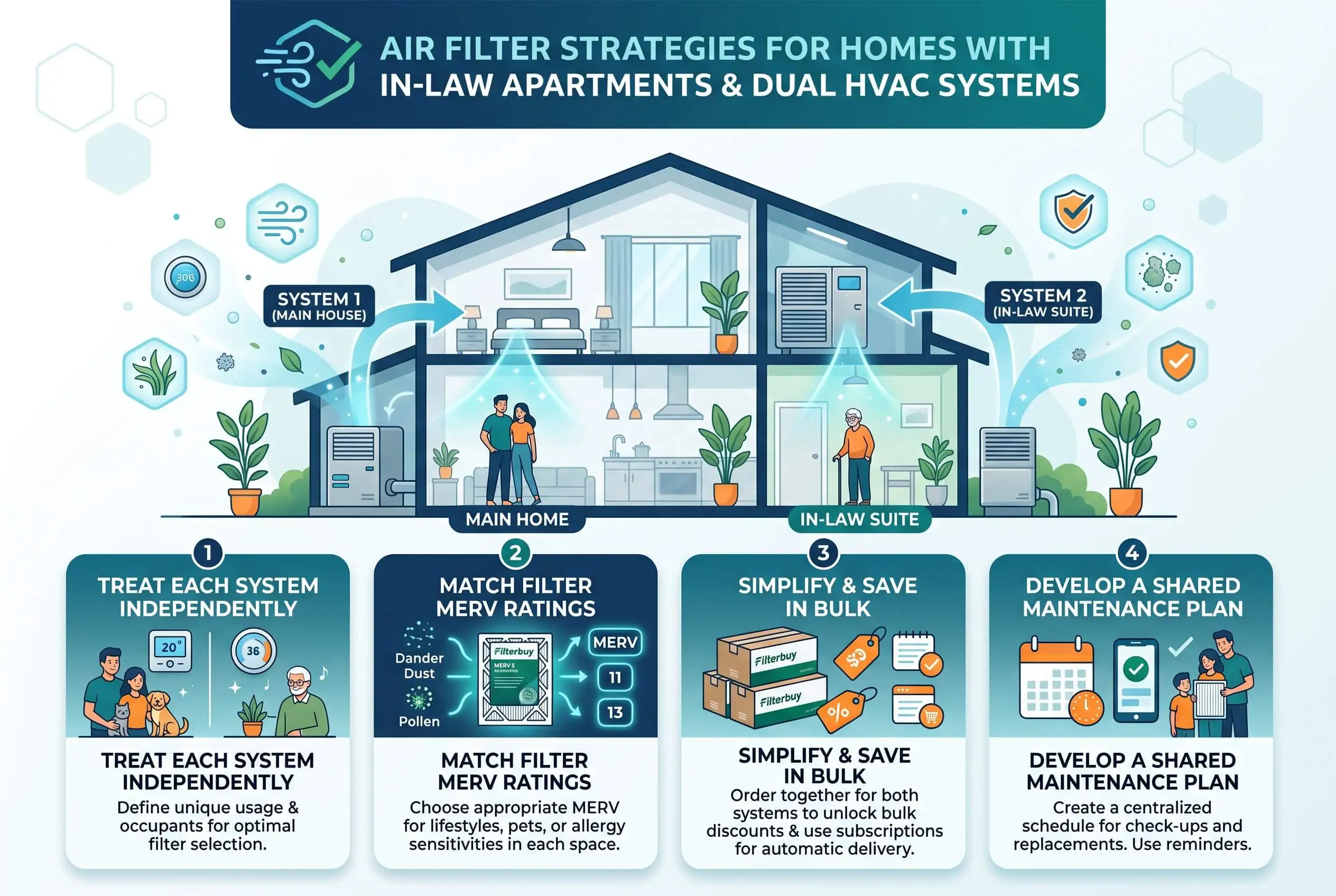
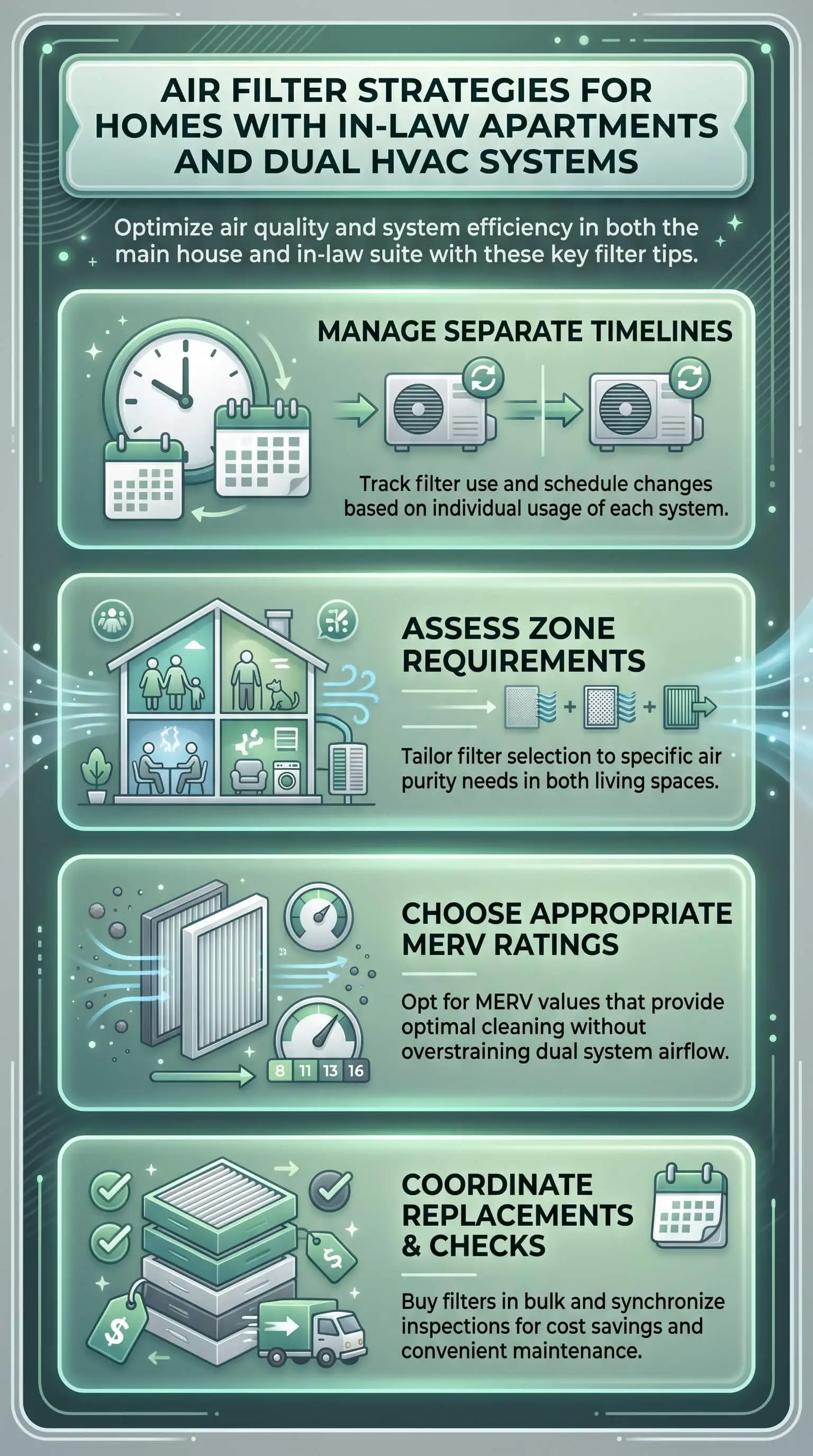
Treat each system as its own decision. Two air handlers means two filtration profiles, not one duplicated spec carried over by habit.
Pick MERV by occupant, not by room. A retiree with asthma needs higher capture than a healthy main-house family does.
Expect sizing mismatches. ADU and casita systems often take non-standard filter sizes that big-box stores skip entirely.
Stagger the two replacement cycles. Four-to-six-week offsets keep maintenance from piling up into one dreaded weekend.
The higher MERV has a ceiling. Older blowers and 1-inch cabinets may not handle MERV 13 without losing airflow.
Two Systems, Two Filtration Decisions
Each air handler in a dual-HVAC home is its own micro-environment. The return ducts pull from different rooms. The blower kicks on for different reasons at different hours, and the filter slot accepts whatever cabinet size the installer built fifteen or twenty years ago. Running the same filter spec in both ignores everything that actually matters about how each system works.
The main house and the in-law unit almost never have matching needs. A main house with kids and pets sees high turnover at the front door, dirt tracked in, and a blower cycling fast against open-and-shut traffic. An apartment with a retiree home most of the day runs differently — fewer doors swinging, but eighteen hours of continuous breathing in the same air. Those are two indoor air quality problems sharing a property line, and each space benefits from a top air filter chosen for how people actually live and breathe there.
What Filters Actually Capture
Every air filter installed in a forced-air HVAC system does two jobs at once. It protects the equipment by keeping dust and debris off the blower motor and evaporator coil. And it improves indoor air quality by trapping particles before they get pulled back through the supply ducts and into someone’s lungs.
The MERV scale (set by ASHRAE Standard 52.2) rates capture efficiency from 1 to 16 on the residential side. Higher numbers catch smaller particles. They also add resistance to airflow, which is where the trade-offs start to bite.
Matching MERV to the People Breathing the Air
We pick the MERV rating for each system based on who actually lives behind it:
MERV 8 for a general baseline — healthy adults, no pets, low sensitivity
MERV 11 for households with pets or mild allergy sufferers
MERV 13 for occupants with asthma, immune compromise, or anyone in a region hit by seasonal wildfire smoke
That logic means the in-law apartment can legitimately run a higher MERV than the main house, or the reverse. The filter follows the lungs.
One honest caveat: higher MERV isn’t automatically better. We’ve watched older blowers struggle with MERV 13 pressure drop, choking airflow and stressing the motor until the system either underperforms or fails early. If the air handler was installed before 2010, or the cabinet only accepts a 1-inch filter, MERV 11 filter is the safer ceiling.
Sizing the Two Systems
Filter sizes between the primary and secondary system rarely match. The main house often takes a common size like 20x25x1 or 16x25x4. The in-law unit, whether it started life as a converted garage or an ADU, frequently takes something like 14x20x1 or 16x20x1, sizes that big-box stores stock inconsistently if they stock them at all.
Two practical steps:
Pull the current filter and measure its actual dimensions, not the nominal printed size. A “16x20x1” can really measure 15.5 by 19.5 by 0.75 inches, and a quarter-inch off either way means it won’t seal properly in the slot.
Source both sizes from the same supplier so reordering is one transaction instead of two. A direct manufacturer carrying a deep range of standard and custom sizes makes that easier than chasing two different store inventories every season.
Scheduling for Two Cycles
Replacing four filters in a single weekend is the kind of chore most homeowners only do once before they start finding reasons to skip it. Staggering the two systems by four to six weeks turns one big maintenance day into two small ones, and the cadence sticks.
ENERGY STAR recommends checking filters monthly and replacing them at minimum every three months, which reinforces the importance of HVAC systems in keeping indoor air moving cleanly and efficiently. In our experience, that schedule holds steady for MERV 8. Higher MERV ratings load up faster — closer to every 60 days in pet households or during the worst of pollen season.
“The mistake we run into most often in dual-HVAC homes is the quiet assumption that both systems should take the same filter. They almost never should. The in-law unit usually houses the household member who’s home the most hours and breathing the same air longest — often a parent or grandparent with asthma, a weaker immune system, or both. That system deserves the higher MERV rating, even when the main house can get by with a lower spec for blower compatibility or budget reasons. Match the filter to the occupant, not the floor plan, and the air on both sides of the wall improves measurably within the first replacement cycle.”
7 Essential Resources
1. EPA — Indoor Air Quality (IAQ)
The EPA’s central hub for residential air quality science. Source control, ventilation, and filtration guidance live here.
URL: https://www.epa.gov/indoor-air-quality-iaq
2. EPA — The Inside Story: A Guide to Indoor Air Quality
A plain-language primer for homeowners on what pollutants live indoors, where they come from, and how each one affects health.
URL: https://www.epa.gov/indoor-air-quality-iaq/inside-story-guide-indoor-air-quality
3. EPA — Asthma Triggers: Gain Control
A trigger-by-trigger walkthrough of the most common indoor allergens and irritants, with high-efficiency HVAC filtration called out by name.
URL: https://www.epa.gov/asthma/asthma-triggers-gain-control
4. U.S. DOE / PNNL — High-MERV Filters
The Building America Solution Center reference on MERV ratings, ASHRAE 52.2, and why MERV 13 is the federal baseline for virus and fine-particle control.
URL: https://basc.pnnl.gov/resource-guides/high-merv-filters
5. ENERGY STAR — Maintenance Checklist
The EPA’s official checklist for what a quality HVAC maintenance visit should cover. Filter inspection is the first item on the list.
URL: https://www.energystar.gov/saveathome/heating-cooling/maintenance-checklist
6. AAFA — Improving Indoor Air Quality
The Asthma and Allergy Foundation’s straight-talk guide to reducing indoor triggers for sensitive household members.
URL: https://aafa.org/asthma/asthma-triggers-causes/air-pollution-smog-asthma/indoor-air-quality/
7. Pew Research Center — Demographics of Multigenerational Households
Pew’s analysis of Census data on how multigenerational living arrangements have grown and reshaped American housing.
Supporting Statistics
Roughly 90% of time is spent indoors. The EPA documents that Americans spend approximately 90% of their time indoors, where pollutant concentrations frequently run two to five times higher than outdoor levels. Whatever air the HVAC system pulls through the filter is the air the household actually breathes.
Source: EPA — Indoor Air Quality (IAQ)
A clogged filter quietly raises HVAC energy use. ENERGY STAR points out that a dirty filter slows airflow and forces the system to work harder, lifting energy costs and shortening equipment lifespan. In a dual-HVAC home, that penalty hits both systems on their own clocks.
Source: ENERGY STAR — Heat & Cool Efficiently
59.7 million Americans live in multigenerational households. Pew Research Center analysis of U.S. Census data found that the number of people sharing multigenerational family households quadrupled between 1971 and 2021, reaching 59.7 million. Every in-law suite and backyard ADU built in the last decade sits inside that demographic shift.
Source: Pew Research Center — Multigenerational Households
Final Thoughts
A dual-HVAC home asks two filtration questions, one for each air handler. The answers rarely should be identical, especially when one side uses residential filters and the other benefits from commercial air filters. When homeowners pick each MERV rating by occupant and stagger the replacement schedule so reorders land four to six weeks apart, the air across the whole property gets cleaner with measurably less effort than the four-filters-one-weekend approach. The filter should follow the person breathing the air. That’s the only rule that consistently holds up across the dual-zone homes we’ve worked with.
Frequently Asked Questions
Can I use the same air filter in both my main HVAC and my in-law apartment system?
Only when both systems share the exact same cabinet size and both households have nearly identical air quality needs. In our experience, that’s rare. Filter sizes between primary and secondary systems usually differ, and occupant sensitivities almost always do.
What if my in-law apartment system uses a non-standard filter size?
Measure the existing filter’s actual dimensions before ordering, not just the nominal printed size on the cardboard. Then source from a direct manufacturer that carries both standard and custom sizes, so you can order both filters from one supplier instead of running between two.
Should an apartment housing an elderly parent run a higher MERV than the main house?
Usually yes. An elderly parent or anyone with asthma, COPD, or compromised immunity benefits measurably from MERV 13 capture, especially when they’re home most of the day. The main house can often run MERV 8 or 11 without affecting indoor air for healthier, less-exposed occupants.
How do I keep track of replacement schedules for two separate systems?
Stagger the change dates four to six weeks apart and set calendar reminders for each system separately. We’ve found that putting the main house on odd months and the in-law unit on even months makes the cadence almost automatic across the year.
Does running a higher MERV filter raise the electric bill?
A higher MERV rating adds airflow resistance, which can increase blower energy use slightly. The bigger energy hit by far comes from letting any filter get clogged. ENERGY STAR points out that a dirty filter forces the system to work harder no matter what MERV rating it started at.
Build a Filtration Plan for Both Systems
A dual-HVAC home calls for two filtration decisions made together, not the same decision made twice. The next step is measuring both filter cabinets and choosing the best air filter for each MERV rating around the person breathing that air.