This guide gives you a direct answer. We’ll walk through the five clearest signs that professional help is the right move, explain what a hoarding cleanout actually involves, and give you what you need to take the next step with confidence — not guilt.
TL;DR Quick Answers
When Should You Call a Professional Hoarding Cleanout Service?
A professional hoarding cleanout service clears, sorts, and removes accumulated possessions from a home affected by hoarding disorder — discreetly, without judgment, and with full disposal handled for you. Call when exits are blocked, pests or mold are present, the home is no longer safely livable, prior cleanup attempts have stalled, or a legal deadline has been issued. JiffyJunk has handled hoarding cleanouts across the United States since 2014, coordinating everything from sorting and donation drop-off to biohazard coordination when needed. One call, one team, one less thing to carry.
Top Takeaways
Hoarding disorder is a clinically recognized mental health condition — not a personal failing — which means professional cleanouts work best when paired with appropriate therapeutic support.
Five clear signs it’s time to call a professional hoarding cleanout service: blocked exits and safety hazards, pest or mold infestation, the home becoming unlivable, failed prior cleanup attempts, and a legal or compliance deadline.
Fires in hoarding conditions are statistically more likely to injure or kill occupants than fires in unobstructed homes — the safety risk is real and well-documented.
Forced cleanouts without the person’s involvement almost always fail to hold. A collaborative, compassionate approach produces better outcomes and keeps things from reverting.
Professional hoarding cleanout teams handle sorting, disposal, and donation coordination — and connect with remediation specialists when the situation calls for it. That’s a different scope than standard junk removal.
When you’re ready to take the next step, JiffyJunk’s hoarding cleanout service provides trained, discreet teams experienced across the full range of hoarding situations.
What Is a Hoarding Cleanout Service?
A hoarding cleanout service is a specialized form of junk removal carried out by teams trained for the physical, logistical, and emotional weight of the work. It’s not a regular cleanout. It’s not a blitz weekend with a rented dumpster. It involves systematic sorting, responsible disposal, donation coordination, and — when the situation calls for it — coordination with remediation specialists for biohazard conditions.
It also helps to understand what you’re actually dealing with. Hoarding disorder is a clinically recognized mental health condition, listed in both the DSM-5 and ICD-11. The Wikipedia overview of compulsive hoarding describes it as a persistent difficulty parting with possessions and excessive accumulation that blocks the safe use of living spaces. A good cleanout team works with that reality rather than against it.
What a hoarding cleanout service does — and doesn’t do — matters. It clears the physical space: removes, sorts, donates, and disposes. It doesn’t replace therapy or treat the disorder itself. But it restores the safe, livable environment that makes everything else possible.
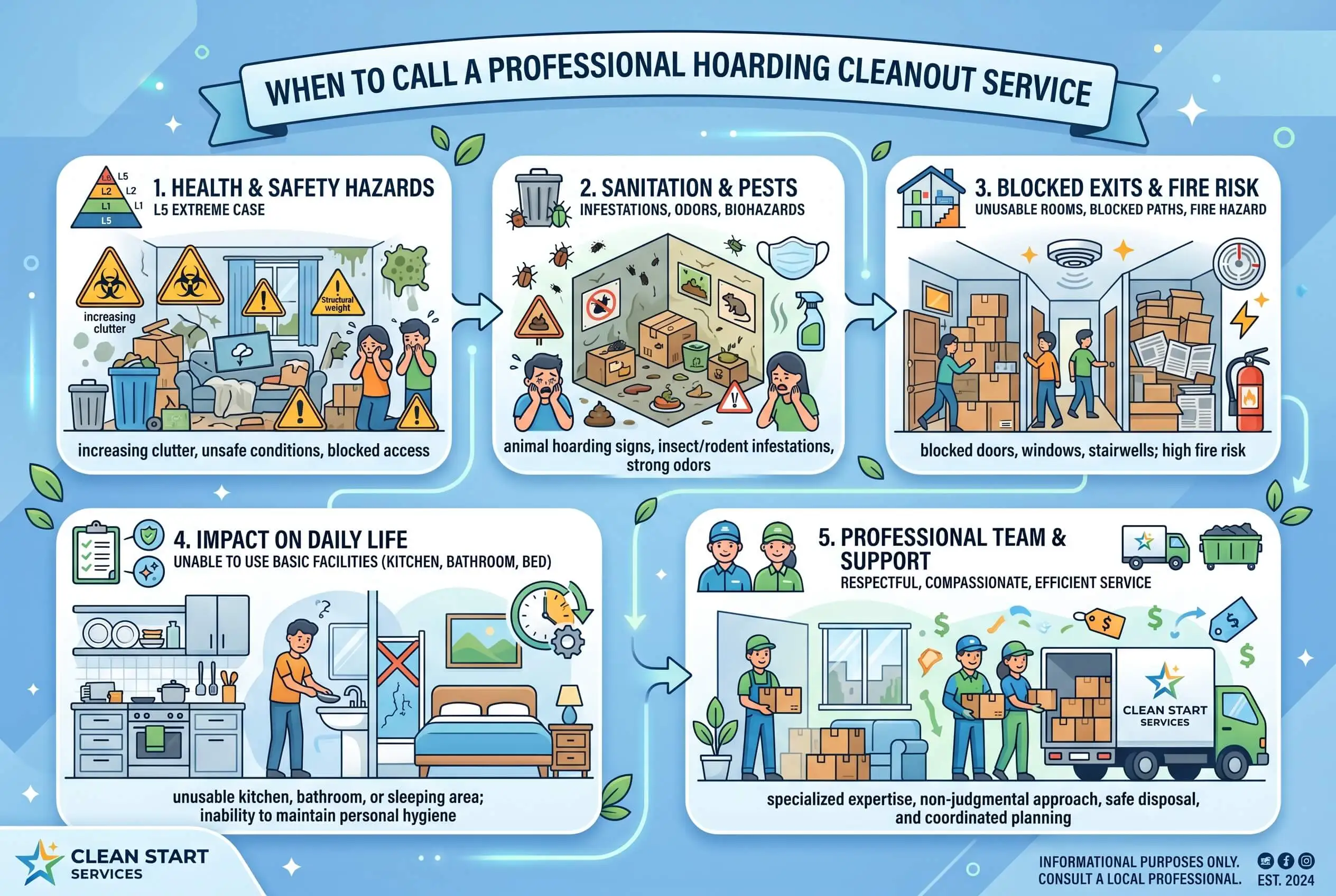
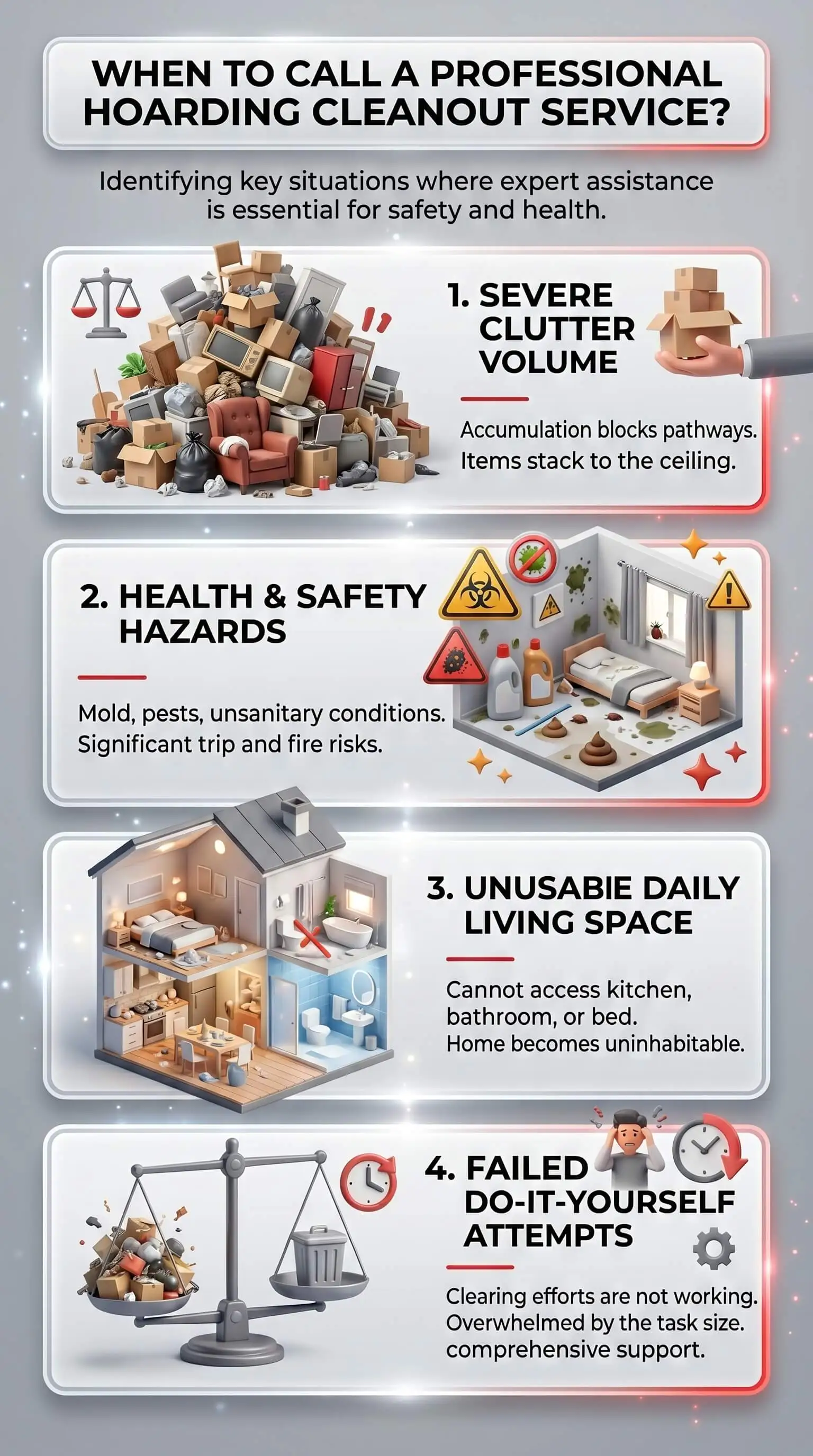
Sign 1: Safety Hazards Have Developed
The clearest signal it’s time to call isn’t how much has accumulated. It’s what prevents accumulation.
When pathways to exits have narrowed or disappeared, when stacked items create fall hazards, when doorways are partially blocked and windows are obstructed — the home has become physically dangerous for everyone inside it. Fire egress is the most urgent concern. The NFPA has documented that hoarding conditions place excessive combustible material near cooking and heating equipment, and that fires in hoarded homes are more likely to cause injuries and deaths than fires in unobstructed residences. First responders can’t move quickly through clutter. Occupants can’t get out.
If you’re walking single-file through rooms, stepping over piles, or navigating by memory because you can’t see the floor, the safety line has been crossed. A professional team can assess the situation and restore clear pathways first, before anything else.
Sign 2: Pest or Mold Infestation Is Present
Accumulated materials create exactly the conditions that pests and mold need. Rodents nest in stacked paper and fabric. Cockroaches find food debris buried in piles. Mold grows where organic material meets moisture that nobody can reach — a leaking pipe behind a wall of boxes, condensation on a window covered by bags.
A cleanout is also a chance to protect the HVAC system before hidden dust, mold spores, odors, and debris keep circulating through the home. Once the clutter is removed, checking the vents, filters, and airflow helps improve indoor air quality and supports a healthier, more livable space.
If you’ve noticed pest droppings, smells you can’t place, visible mold, or water-damaged materials buried in the accumulation, the situation has moved past clutter management. It needs professional attention now.
Sign 3: A Family Member Can No Longer Safely Live in the Home
This is the hardest sign to name — and usually the one that finally prompts the call.
When a kitchen is too packed to cook a meal, when a bathroom is inaccessible or nonfunctional, when there’s no clear path to a bed, the home has stopped working for the person living in it. For older residents, that’s a compounding problem. Falls are the leading cause of injury-related deaths among adults over 65, and cluttered floors drive that risk up sharply. For anyone with limited mobility, even moderate accumulation can make safe movement impossible.
Recognizing this sign takes honesty about a situation you care about deeply. That recognition isn’t a failure. It’s the thing that prompts the call that changes things.
Sign 4: Prior Cleanup Attempts Have Failed or Stalled
Most families try on their own first. They plan a big weekend, sort through a few bags, and then it stops. The emotional weight of each decision becomes too much. The person whose belongings are involved gets distressed. The piles shift but don’t shrink. A few weeks later, new items fill whatever space was cleared.
This cycle isn’t a character flaw. It’s what hoarding disorder does. Discarding feels like loss, and DIY efforts rarely account for that. A professional hoarding cleanout team brings a structured sorting process, a system for working through decisions, and genuine experience handling the emotional complexity of this work — without judgment.
If you’ve tried before and stalled, that’s not a reason to quit. It’s a reason to try a different approach with full service junk removal — one that gives you hands-on help with sorting, lifting, hauling, disposal, and cleanup so the process feels manageable instead of overwhelming.
Sign 5: A Legal or Housing Compliance Issue Is Involved
Sometimes the timeline gets set by someone outside the family. A landlord issues a notice. Code enforcement documents violations. An estate attorney identifies a property that needs to be cleared for probate. A social worker flags unsafe conditions during a wellness check.
When legal deadlines enter the picture, DIY timing — weekends, whenever family can coordinate, whenever it feels manageable — stops being a workable plan. Professional hoarding cleanout teams run on defined schedules, can document completed work, and have experience coordinating estate, foreclosure, and compliance-driven cleanouts where precision and pace both matter.
If an outside party has set your deadline, professional help isn’t optional. It’s a logistical requirement.
What to Expect from a Professional Hoarding Cleanout
A reputable professional hoarding cleanout service starts with a real conversation — an honest assessment of the scope, the timeline, and any conditions that need special handling, like biohazard materials, coordination with a loved one still in the home, or an estate situation with multiple stakeholders. From there, the team works through the space room by room: sorting into keep, donate, and dispose categories, hauling away what needs to go, and leaving the space clear and accessible.
The best teams are discreet. They know that making this call took something, and that what they’re walking into reflects a medical condition — not a personal failure. Judgment isn’t part of how they work.
Timeline depends on severity and square footage. One room can often be handled in a day. A whole-home cleanout with years of accumulation may take several sessions. A good team gives you an honest scope at the intake conversation — not an optimistic estimate designed to win the job.
“Forced cleanouts — where family members or workers remove possessions without the person’s involvement — almost always make things worse. Items come back. Trust is broken. The underlying condition goes untreated. The most effective cleanouts pair a professional removal team with a mental health provider who specializes in hoarding disorder. The physical work and the therapeutic work have to happen together, or the results don’t last.”
7 Essential Resources
Whether you’re getting ready for a cleanout, trying to understand what a loved one is going through, or looking for mental health support to pair with the physical work, these resources are the most authoritative available.
1. International OCD Foundation — Hoarding Center
The IOCDF Hoarding Center is the most complete clinical resource on hoarding disorder in the United States. It offers a treatment provider directory, family education materials, support group listings, and research updates. Start here if you need to find a therapist who specializes in hoarding disorder.
2. USFA / FEMA — Hoarding and Fire Safety
usfa.fema.gov/prevention/home-fires/at-risk-audiences/hoarding/
The U.S. Fire Administration’s hoarding resource page covers the specific fire risks tied to excessive accumulation, practical safety guidance for residents, and materials for communicating fire safety in hoarding environments. Particularly useful when fire code concerns are already part of the situation.
3. Mayo Clinic — Hoarding Disorder: Diagnosis and Treatment
mayoclinic.org/diseases-conditions/hoarding-disorder/diagnosis-treatment/drc-20356062
Mayo Clinic’s clinical overview covers diagnosis criteria, treatment options, and what families can realistically expect from the treatment process. It’s the most accessible medically authoritative summary available, and a useful reference when conversations about professional help become necessary.
4. American Psychological Association — Treating People with Hoarding Disorder
apa.org/monitor/2020/04/ce-corner-hoarding
This APA clinical education piece outlines the evidence for treating hoarding disorder, including the gold-standard 26-session CBT protocol developed by Dr. Randy Frost and Dr. Gail Steketee. It explains clearly why forced cleanouts without therapeutic support rarely hold — essential reading for families trying to understand the full picture.
5. Wikipedia — Compulsive Hoarding
en.wikipedia.org/wiki/Compulsive_hoarding
A well-sourced overview of the disorder’s definition, clinical recognition, prevalence estimates, co-occurring conditions, and treatment approaches. A reliable starting point for families who are new to the terminology and want solid footing before talking to a professional.
6. National Fire Protection Association — Hoarding
nfpa.org/education-and-research/emergency-response/hoarding
The NFPA’s hoarding resource hub documents the fire risks of hoarding environments and treats the issue as a community health concern rather than a code enforcement problem alone. Especially useful when official notices or fire code violations are already in play.
7. JiffyJunk — Hoarding Cleanout Services
When you’re ready to move from research to action, JiffyJunk’s professional hoarding cleanout service provides compassionate, discreet, judgment-free removal by trained teams who handle these situations every day. Services cover whole-home clearing, sorting, donation coordination, and disposal.
3 Statistics
An estimated 6 to 16 million Americans meet clinical criteria for hoarding disorder — roughly 2% to 5% of the adult population — with prevalence climbing sharply among adults over 70.
Source: Chicagoland Hoarding Taskforce — Hoarding Statistics, citing meta-analysis data; cross-referenced with Wikipedia: Compulsive Hoarding
Residential fires in hoarding conditions are more likely to injure at least one person (8.3% vs. 5.2% in non-hoarding fires) and twice as likely to cause a death (4.2% vs. 2.1%) compared to fires in unobstructed homes.
Source: Dozier & Porter (2023), Journal of Public Health in the Deep South — peer-reviewed analysis of 5,194 residential fires, 2009–2019.
Hoarding disorder is associated with approximately 25% of residential fire deaths nationally — a figure that reflects both the volume of combustible material in hoarded homes and the blocked exits that prevent escape. [VERIFY: confirm the 25% figure maps precisely to the UF Health source before publishing]
Source: University of Florida Health Research, citing national fire mortality data reviewed by UF Health psychiatrist Carol Mathews, MD.
Final Thoughts
Calling a professional hoarding cleanout service is rarely the first thing a family tries. Understanding that a loved one is living with a recognized disorder, approaching the situation with patience, and finding the mental health support that can address the underlying condition — all of that matters and all of it takes time.
But there are moments when the physical environment becomes the most urgent problem. When safety hazards develop, when the home is no longer livable, when legal deadlines arrive, or when every prior attempt has stalled — those moments call for professional help. Not as a last resort. As the appropriate, practical next step.
None of the five signs we covered here require the others to be present before you act. A blocked exit is reason enough to call. So is a family that has been trying and getting nowhere for years. You don’t need to wait for things to get worse.
What matters most is that choosing professional junk removal comes from a place of care — for the person in the home, for the family working through this, and for everyone who has been carrying the weight of a situation that’s been building longer than anyone would like. The people who do this work do it because they’re good at it and because they understand what it means to be trusted with something this personal. That’s the standard worth holding them to.
Frequently Asked Questions
How much does a hoarding cleanout service cost?
Cost depends on the size of the home, the volume of material, and whether remediation is needed alongside the removal. Most professional teams offer a free assessment so you can get a real number before committing to anything. A single-room cleanout and a full whole-home clearing with years of accumulation are very different jobs — pricing reflects that.
How long does a professional hoarding cleanout take?
A moderate single-room cleanout can often be done in a day. Whole-home cleanouts in more severe situations may take several sessions spread over multiple days. A team worth hiring will give you an honest timeline at the intake conversation based on what they actually see — not an optimistic estimate built to win the booking.
Will a hoarding cleanout service handle biohazard materials?
Many professional hoarding cleanout teams are equipped for biohazard conditions, or work alongside licensed remediation specialists when needed. If pest infestation, sewage, animal waste, or significant mold is part of the situation, mention it during your first conversation. That gives the team time to confirm their capabilities and bring the right resources.
How do I prepare a family member for a hoarding cleanout?
Involving the person in the process — not just telling them after decisions have been made — produces meaningfully better outcomes. If possible, connect them with a therapist who specializes in hoarding disorder before or during the cleanout. The IOCDF treatment directory at hoarding.iocdf.org is the best place to find one. Frame the cleanout around restoring safety and comfort, not around evaluating the person.
Is a hoarding cleanout covered by insurance?
Standard homeowner’s insurance typically doesn’t cover hoarding cleanout services. In some cases, when a cleanout ties directly to a covered event — fire damage, flood, documented pest remediation — portions of the work may qualify. Check with your provider directly, and ask your cleanout service whether they have experience working with insurance documentation.
Ready to Take the Next Step?
You’ve got a clear picture of what to look for. You understand what’s at stake.
The next step is to book junk removal with a team that handles this work every day — with the care, the discretion, and the experience it takes to do it well.