Here's why. Two pollutants run on two different clocks over Chicago, and Lake Michigan keeps rearranging both. Traffic particles peak in the morning under a low overnight lid. Ozone builds all afternoon, then often rides a lake breeze straight back onto the shoreline. You can watch it happen on the air quality index Chicago monitors hour by hour, and once you see the pattern, planning your family's day around cleaner air gets much easier.
TL;DR Quick Answers
air quality index Chicago
The air quality index in Chicago tracks ozone, fine particles and other pollutants on EPA’s 0 to 500 scale, where readings above 100 are unhealthy for sensitive groups. Chicago’s number swings by the hour, with traffic particles peaking during the morning rush and ozone climbing through the afternoon, often riding a lake breeze onto the shoreline.
Check the hour, not the day: AirNow averages ozone over eight hours and particles over 24, so the daily figure flattens the afternoon peak you’ll actually breathe.
The lakefront isn’t always cleanest: On about half of days from May through September, a lake breeze can carry ozone formed over Lake Michigan back onto shoreline neighborhoods.
Know the alert trigger: Illinois EPA calls a Chicago Air Pollution Action Day when Orange (101 or higher) is forecast for two or more days in a row.
Ozone is the metro’s weak spot: The American Lung Association’s State of the Air 2026 report ranks Chicago-Naperville 15th worst of 226 U.S. metros for ozone.
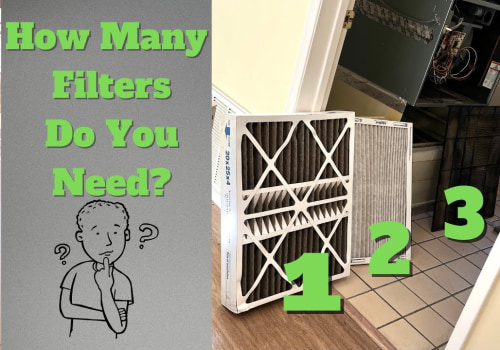
Protect the air inside: Switch your HVAC fan to On during elevated readings and keep a fresh filter in place, since fine particles drift indoors and linger.
Top Takeaways
Two pollutants keep two schedules. Particles and nitrogen dioxide peak with the morning commute, while ozone builds through the afternoon.
An overnight lid traps rush hour exhaust. The temperature inversion holds emissions near street level until late morning.
Lake Michigan hands ozone back. Overnight emissions can return as ozone-rich air on the afternoon lake breeze.
Shoreline and inland readings can split sharply. On lake breeze days, ozone near the water can run well above inland readings.
The daily number flattens the swing. Eight-hour ozone and 24-hour particle averages hide hourly peaks, so check the hour you'll actually be outside.
A Chicago Air Day, Hour by Hour
Here's a typical warm-season weekday. The timing shifts with the weather, but the shape holds up surprisingly often.
Before Sunrise: A Lid Over the City
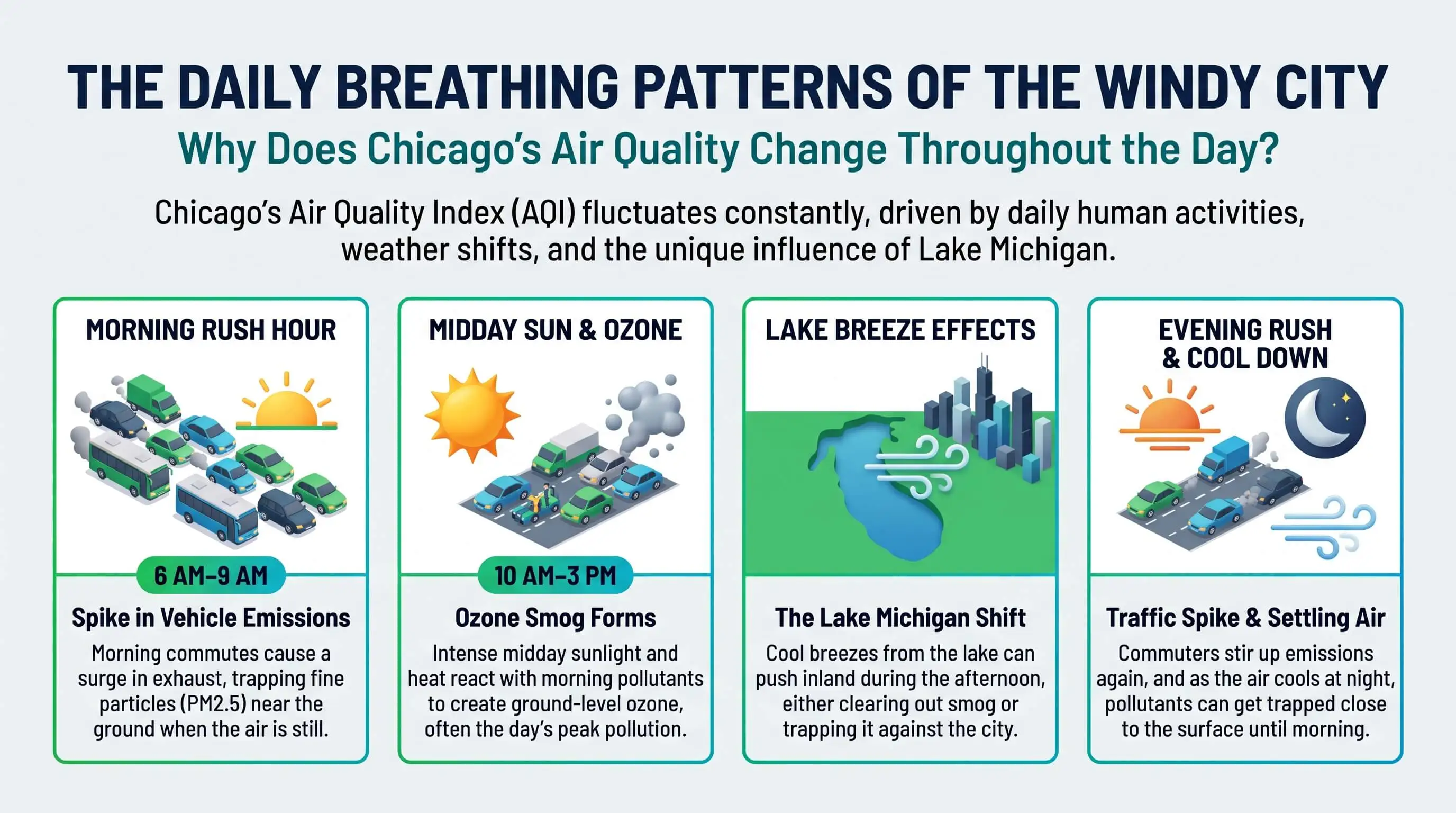
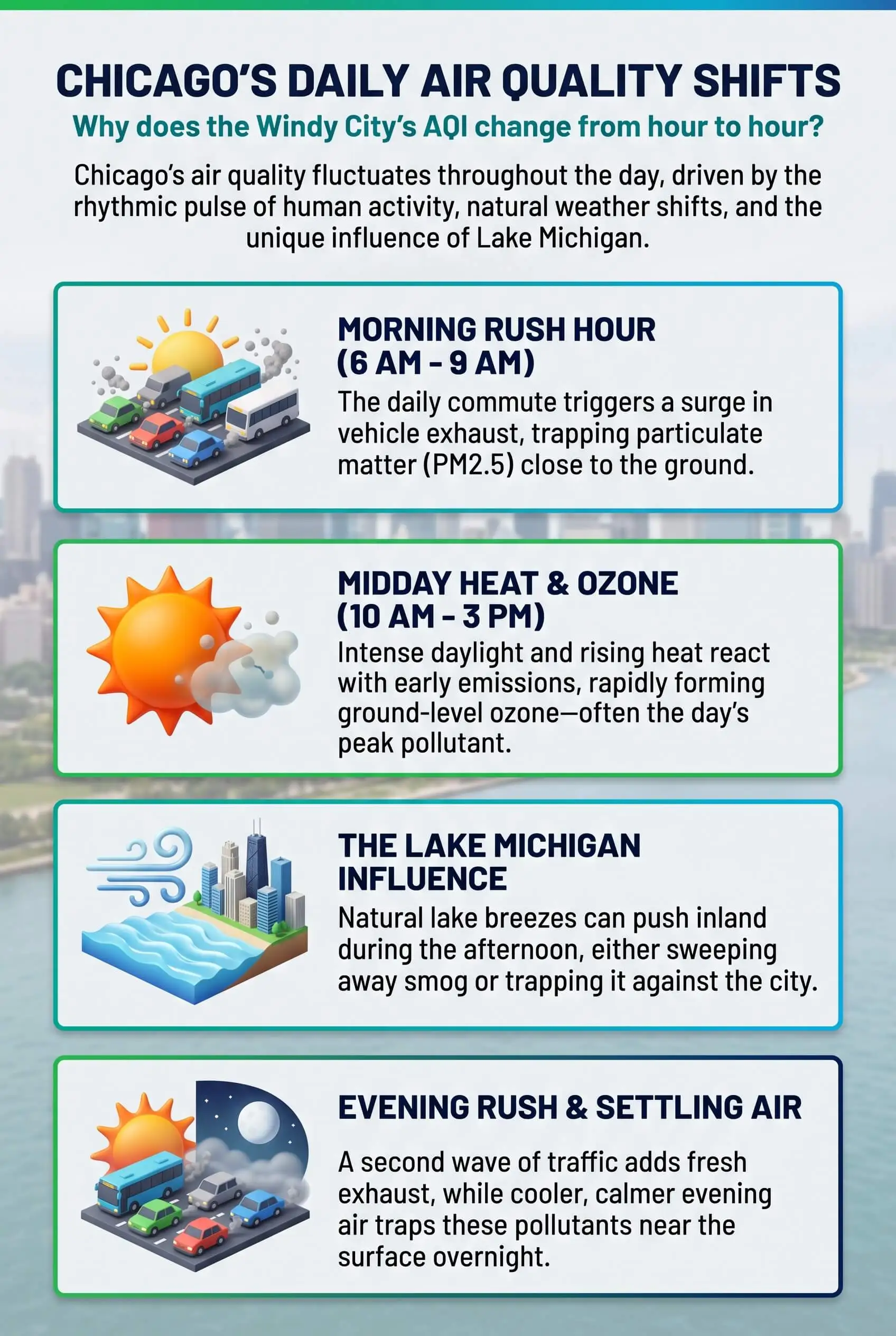
Clear, calm nights let the ground cool faster than the air above it. The National Weather Service calls that a temperature inversion, a layer where air warms with height instead of cooling. Think of it as a lid. While it sits there, a light land breeze drifts off the city and carries the previous evening's emissions out over the lake.
Morning Rush: Exhaust Held Near the Ground
Then Dan Ryan, Eisenhower, Kennedy and Stevenson fill up with the lid still on. Exhaust particles and nitrogen dioxide hang at street level, right where you walk the dog and sit in the school drop-off line. Researchers flying the 2017 Lake Michigan Ozone Study measured roughly four times more nitrogen dioxide over Chicago on a Monday than the Sunday before, and they tied the peak to morning rush hour. Blocks hugging the expressways and the O'Hare corridor take the worst of it.
Midday: The Lid Lifts
By late morning the sun has broken the inversion. Air mixes upward. Particle readings ease, and for a lot of neighborhoods this turns into the cleanest stretch of the day.
Afternoon: Ozone Builds and the Lake Sends It Back
Sunlight builds ozone out of those morning gases over several hours, so the reading keeps climbing after lunch. Then the lake adds a twist. The emissions that drifted offshore overnight settle into a shallow layer over the cool water, react there, and ride the afternoon lake breeze back onto land. EPA researchers describe what arrives as photochemically aged, ozone-rich air.
Evening: A Second Rush and a Slow Settle
Ozone fades once the sun goes down. The evening commute adds a second round of particles, and as the ground cools, the lid starts settling back into place for tomorrow.
Why Lake Michigan Makes Chicago Different
Chicago sits on the southwestern shore of Lake Michigan, and that water shapes your daily air more than most people realize. A NOAA study cites research showing Chicago gets a lake breeze on about half of all days from May through September. When it blows, the shoreline and a neighborhood a few miles west can breathe very different air. In the 2017 study, shoreline ozone near Zion hit the low to mid 80s in parts per billion while sites more than four kilometers inland read about 57.
Here's something that might surprise you. The lakefront feels fresher because the breeze is cool, yet on hot afternoons those blocks can log some of the metro's highest ozone, while inland expressway corridors carry more of the morning particle load.
Why the Air Quality Index Chicago Number Hides the Swing
The headline number smooths out the exact swing you're trying to catch. AirNow figures the ozone AQI over eight hours and the particle AQI over 24, so a single daily figure has no way to show a 4 p.m. ozone peak or a 7 a.m. particle spike.
Alerts follow the same logic. The Illinois EPA posts each forecast the afternoon before and calls an Air Pollution Action Day for the Chicago area only when Orange (Unhealthy for Sensitive Groups) or worse shows up for two or more days in a row. One rough afternoon may never trigger an alert.
Wildfire smoke throws all of this out the window. A Canadian plume can push readings up at any hour, so on smoky days the live number is the one that counts. Having the best air filters in your home can also help capture smoke particles and maintain cleaner indoor air.
Timing Your Day Around Cleaner Air
You can't move the lake breeze. You can decide when your family meets it.
Get the run or bike ride in early on hot, sunny days. Ozone sits at its lowest in the morning, though on still mornings I'd skip routes right beside the expressways.
Open the windows late morning. The lid has broken by then, and ozone hasn't started building.
Keep them shut on hot lakefront afternoons whenever the forecast calls for ozone to climb.
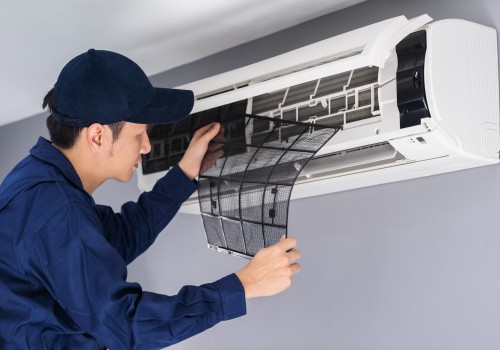
Flip the system fan from Auto to On during elevated readings so air keeps cycling through the filter.
Check your filter before the heat wave or smoke event shows up. A MERV 13 filter traps far more fine particles than a basic one, as long as your system can handle it.
Indoors, ozone breaks down fairly fast. Fine particles drift in and hang around. Your filter is the one piece of this you fully control, and choosing high quality filters helps protect everyone under your roof when the outdoor air turns.
"Most people assume the lakefront has the cleanest air in Chicago, and on a cool, breezy morning it usually does. In my experience, that same breeze on a hot July afternoon carries ozone that formed over the water right back onto the shoreline, so I tell families to check the reading for the hour they'll actually be outside instead of the one they saw at breakfast."
7 Essential Resources
Find Out What the Daily Number Actually Measures
AirNow explains the averaging window behind each pollutant and how forecasters build tomorrow's number.
Resource: https://www.airnow.gov/aqi/aqi-basics/using-air-quality-index/
See What Triggers a Chicago Action Day
Illinois EPA spells out its forecast sectors and the exact rules behind Chicago, Statewide and Red Action Days.
Resource: https://epa.illinois.gov/topics/air-quality/outdoor-air.html
Learn Why Shoreline Ozone Is So Hard to Predict
A short EPA piece on why air quality models keep missing the lake breeze.
Put a Name to the Morning Lid
The weather service definition of an inversion, the cause of most hazy Chicago mornings.
Resource: https://forecast.weather.gov/glossary.php?word=inversion
Read the Study That Tracked Chicago's Plume
The primary research that followed Chicago's air over the lake and back. Dense, and worth it.
Resource: https://pmc.ncbi.nlm.nih.gov/articles/PMC9275376
Watch Ozone Travel From the City to the Shore
EPA Region 5 scientists map how the morning land breeze and afternoon lake breeze shuttle ozone along the shoreline.
Resource: https://cmascenter.org/conference/2017/slides/liljegren_elevated_ozone_2017.pdf
Know Who Smoke Hits Hardest
The CDC lays out who faces higher risk from wildfire smoke, including children and anyone with asthma, COPD or heart disease.
Resource: https://www.cdc.gov/wildfires/risk-factors/index.html
Understanding Chicago's daily air quality means knowing how pollution levels change with lake breezes, temperature inversions, ozone formation, and wildfire smoke. These resources explain what drives those changes, who faces the greatest health risks, and why a properly maintained HVAC system can help reduce indoor exposure to airborne particles when outdoor air quality worsens.
3 Statistics
Chicago Ranks 15th Worst of 226 Metros for Ozone
The American Lung Association's State of the Air 2026 report placed Chicago-Naperville 15th worst in the nation for ozone, with 18 unhealthy ozone days a year and an F for Cook County. The metro also landed 13th worst of 211 for year-round particle pollution.
Source: https://www.lung.org/media/press-releases/fy26-sota-illinois
A Lake Breeze on About Half of Warm-Season Days
Research cited in a NOAA study found Chicago gets a lake breeze on roughly half of all days from May through September.
Source: https://repository.library.noaa.gov/view/noaa/60138
A Lake Breeze on 76 to 82 Percent of High-Ozone Days
Researchers studying Lake Michigan shoreline monitors found a lake breeze present on 76 to 82 percent of days when ozone hit 70 parts per billion for at least an hour.
Source: https://par.nsf.gov/servlets/purl/10340279
Final Thoughts and Opinion
I'll say it plainly. Checking the AQI over breakfast and planning a five o'clock lakefront run around that number is guesswork with a decimal point. The lake breeze makes that guess worse here than in most cities, because the spot that feels freshest at dawn can carry the heaviest ozone by late afternoon.
In fairness, nobody needs hourly readings all day. One check at the hour that matters covers most of the benefit, a habit that pays off in cities like Boston too.
These are tendencies, and a stalled front or smoke plume can scramble them by mid-afternoon. That's the argument for checking live conditions and keeping a fresh pleated furnace filter in place
Frequently Asked Questions
Is Chicago air quality worse in the morning or the afternoon?
That depends on the pollutant. Mornings run worse for traffic particles and nitrogen dioxide, which an overnight inversion pins near the ground during rush hour. Afternoons run worse for ozone, since it needs hours of sunlight to build. Neither half of the day comes out clean, making MERV 8 pleated furnace air filters a practical option for capturing some airborne particles that enter your home.
What time of day is ozone highest in Chicago?
Usually mid to late afternoon on hot, sunny days. Sunlight builds ozone gradually, and on lake breeze days the shoreline often peaks once ozone from over Lake Michigan blows back in.
Why does the air quality index Chicago reports differ near the lake?
Lake Michigan runs its own wind pattern. Overnight, emissions drift out over the water, and in the afternoon a lake breeze can push the ozone that formed there back onto the shoreline. Inland neighborhoods usually see less ozone and more morning particle pollution from the expressways.
What triggers an Air Pollution Action Day in Illinois?
For the Chicago area, Illinois EPA declares an Action Day when the forecast calls for Orange (Unhealthy for Sensitive Groups) or worse on two or more consecutive days. Statewide and Red Action Days follow their own thresholds.
When is the best time to open windows in Chicago?
Late morning, after the inversion breaks and before ozone gets going. On hot afternoons with an ozone forecast, or anytime smoke is around, keep them closed and let your HVAC fan and filter carry the load.
Check Chicago's Air at the Hour That Matters to You
Chicago's air changes throughout the day as rush hour traffic and the lake breeze take turns shaping it. Check the live reading for the hour you'll be outside, and make home air filters part of your everyday protection against airborne particles. Keeping your filters fresh helps maintain cleaner indoor air so your household can breathe easier, whatever the afternoon brings.