So yes, the air here shifts between morning and evening. It shifts more than the daily number will ever show you, and most folks have the direction backwards. Years of pulling used filters out of homes and looking hard at what loaded onto them taught me something useful: paying closer attention to air quality Boston conditions can make it easier to recognize when indoor air is at its best and when a few simple adjustments can help keep it that way.
TL;DR Quick Answers
Air Quality Boston
Boston air quality changes by the hour, not just by the day. Mornings carry traffic particles held low by an overnight inversion, and afternoons carry ozone that sunlight builds. Check EPA AirNow at airnow.gov for official readings, and check at the hour you'll actually be outside.
Official source: EPA AirNow pulls regulatory-grade data from state monitoring stations. Start there.
Neighborhood-level detail: PurpleAir sensors update every couple of minutes and show block-by-block differences a citywide average erases.
Worst window for ozone: afternoon into early evening on warm, sunny days. That's when most people exercise outdoors.
Worst window for traffic particles: morning rush, while the overnight inversion is still capping the air near street level.
Why the daily number looks flat: EPA averages ozone over eight hours and fine particles over twenty-four, so the swing gets smoothed away before you see it.
What it means indoors: the outdoor reading sets what your filter has to handle. Switch the system fan from Auto to On during elevated readings and check the filter before a hot stretch, not after.
Top Takeaways
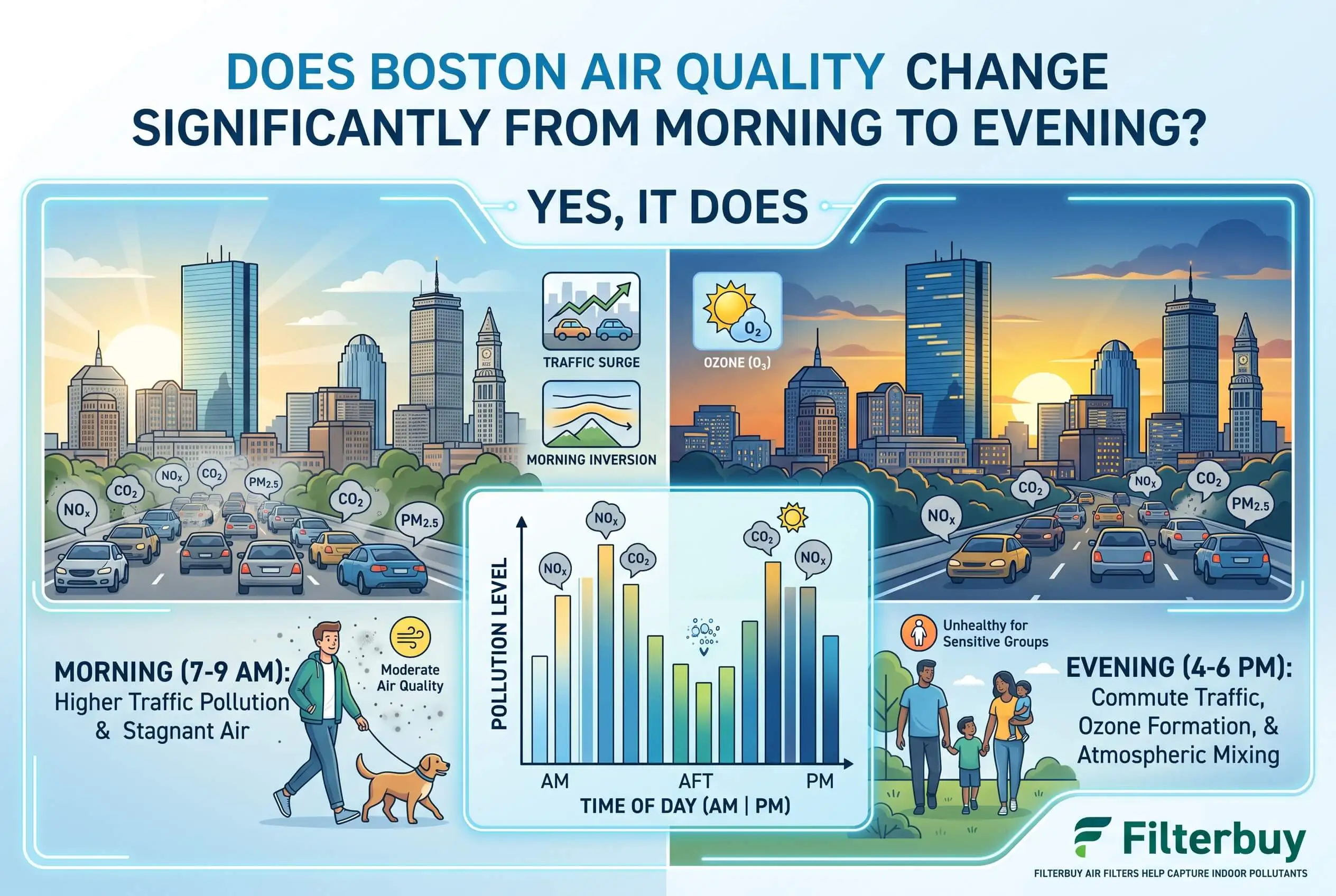
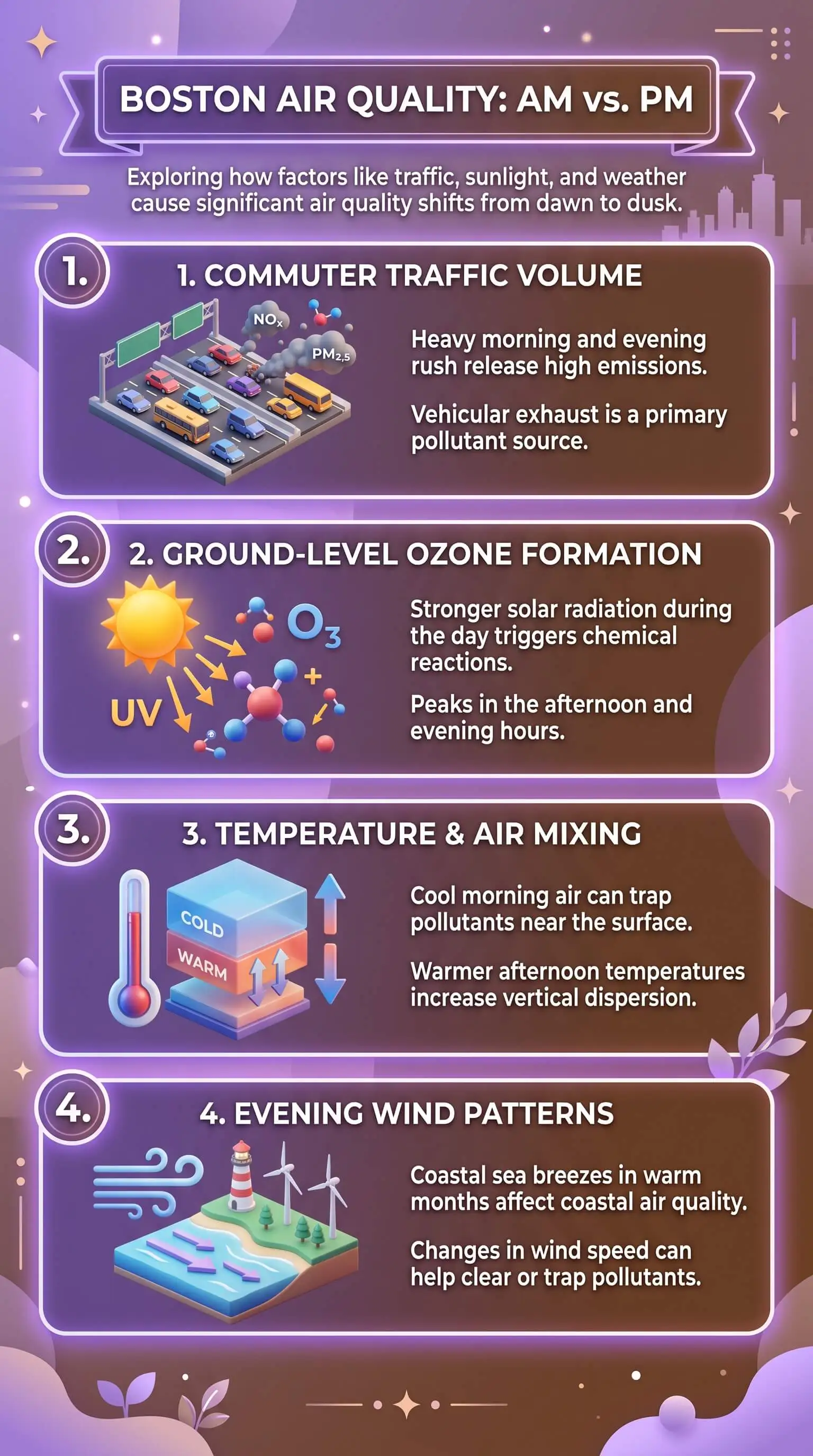
Morning and evening go bad in different ways. Mornings tilt toward traffic particles and nitrogen dioxide pinned low by an overnight inversion. Afternoons and early evenings tilt toward ozone.
Clean-smelling air isn't a reading. The same inversion that makes a Boston morning feel crisp is holding rush hour exhaust down at street level where you're breathing it.
One daily figure can't show a peak. EPA averages ozone over eight hours and fine particles over twenty-four, which smooths the swing away before it ever reaches your screen.
The metro is not one number. An afternoon sea breeze can keep the waterfront clearer while pushing ozone inland over the Route 128 communities.
Time your windows, then let filtration handle the rest. Mid to late morning is usually the best window to air out a house. On a hot afternoon, keep them closed and let the system fan run.
What Actually Changes Between 7 a.m. and 7 p.m.
Two curves run through a Boston day, and they peak at different hours. The first is particles and nitrogen dioxide coming off tailpipes, which climbs when traffic climbs and can influence the air quality index. The second is ground-level ozone, and nothing emits ozone directly. Sunlight assembles it during the day out of those same tailpipe gases, so it needs hours of daylight before it amounts to much. Morning and late afternoon behave like two different cities stacked on top of each other.
Why Morning Air Reads Clean and Still Isn't
On a clear, calm night the ground sheds heat fast, and the air right above it cools quicker than the air a few hundred feet up. That flips the normal layering. The National Weather Service calls what forms a nocturnal inversion, a warm lid resting on cool surface air, and it usually breaks apart soon after sunrise. Until it does, anything emitted underneath it has nowhere to go. Morning rush hour on I-93 and Storrow Drive pushes exhaust straight into a layer that's still capped.
You can't see any of it. That's the maddening thing about air, and it's why I keep coming back to filters. A filter is the only record most households keep of what actually moved through the house, and the ones I pull from homes near heavy morning traffic don't look anything like the ones from quieter blocks.
The Afternoon Ozone Climb
Once the sun gets high, the lid lifts and mixing improves. Particles benefit from that. Ozone goes the other way entirely. Federal guidance states the timing plainly: ozone forms in sunlight, usually on hot days, and it turns worse in the afternoon and early evening. That's exactly when people run along the Charles, drop kids at a field, or throw open every window because the house has finally warmed up.
The alert hours tell the same story. One Boston metro ozone alert this past May ran from eleven in the morning until eleven at night, which puts the risk window nowhere near dawn.
The Sea Breeze That Most Boston Guides Skip
There's a local wrinkle worth knowing about. Boston sits on a filled peninsula on Massachusetts Bay, and on warm afternoons the water pushes a cooler breeze inland. That breeze can hold ozone formation down near the waterfront while the plume drifts west over inland neighborhoods and the Route 128 towns. One "Boston air quality" figure rarely describes the whole metro. A downtown reading and a Newton reading can land in different categories on the same afternoon, which makes a citywide average a shaky guide to your own block.
Why the Daily AQI Number Hides the Swing
The averaging buries the pattern. EPA reports ozone as an eight-hour index and fine particles as a twenty-four hour average, and live figures run through a rolling calculation called NowCast rather than a raw hourly reading. Every one of those choices has sound science behind it. Together they also mean a single daily figure can't show you an afternoon peak, no matter how carefully you read it. So if you want the real shape of a day, check conditions for the hour you'll actually be outside. A live Boston AQI map gives you that current picture, and hourly monitor-level data lets you watch the curve build through the afternoon. MERV 8 pleated HVAC furnace air filters should be a priority for helping capture airborne particles that make their way indoors.
What This Means Once You Are Indoors
Most people act on all this by opening a window, so timing matters more than they'd guess. Early morning during a stagnant stretch is a poor moment to air out a house. Mid to late morning, after the lid breaks and before ozone gets going, usually works better. On a hot afternoon with an alert posted, keep them shut.
Past that, filtration is the piece you actually control, and this is where you get to be the one protecting your household rather than reacting to it. Flip the system fan from auto to on so it circulates continuously instead of only during a heating or cooling call. Check the filter before a hot stretch instead of after it. And get familiar with what a higher MERV rating is doing for you, because the way a system got installed in the first place also shapes what ends up in your indoor air.
"Ozone doesn't come out of a tailpipe ready-made, and it gets assembled over the course of the day, so a clean reading at breakfast tells you very little about what your kid is breathing at a five o'clock practice. I've watched families push practice an hour later to dodge the heat and land squarely on the peak instead, which is also why keeping your HVAC system ready to manage the air coming indoors matters when outdoor conditions worsen."
7 Essential Resources
See the Hour-by-Hour Reading Instead of Today's Grade
Click any single monitor on the federal interactive map and it hands you that station's NowCast value plus the raw concentrations, then plots them as a chart. Nothing else makes the daily swing this obvious this quickly.
Resource: https://gispub.epa.gov/airnow/
Learn Exactly When Ozone Turns Against You
One page. It states the timing without hedging and gives activity advice by category. If anyone in your house runs, rides, or plays outside, print it and stick it somewhere everybody walks past.
Resource: https://document.airnow.gov/air-quality-guide-for-ozone.pdf
Understand What the Number Is Actually Measuring
This one explains the difference between a forecast, an observation, and a NowCast value, along with the averaging window sitting behind each pollutant. Read it once and the daily figure stops being confusing forever.
Resource: https://www.airnow.gov/aqi/aqi-basics/using-air-quality-index/
Get Forecasts Built for Massachusetts Weather
The state environmental agency forecasts ozone daily through the warm season and fine particles all year, using a monitoring network placed with local conditions in mind. There's a phone line too, if you'd rather not stare at another screen.
Resource: https://www.mass.gov/air-monitoring-in-massachusetts
Check the Long Record Behind Today's Reading
Annual reports and network plans lay out pollutant trends across the state going back a decade. Useful when you're trying to work out whether a rough week is unusual or just Tuesday.
Resource: https://www.mass.gov/air-quality-reports-plans-data
Put a Name to Your Hazy Morning
The weather service definition of a nocturnal inversion, including why it forms overnight and why it erodes quickly once the sun comes up. Short, precise, and the mechanism behind half of what you just read.
Resource: https://forecast.weather.gov/glossary.php?word=nocturnal
See How the Boston Metro Grades Out Against the Country
An annual report card covering ozone and both measures of particle pollution for the Boston-Worcester-Providence area, broken out by county. Good for checking whether your instincts about local air are calibrated or just familiar.
Resource: https://www.lung.org/research/sota/city-rankings/msas/boston-worcester-providence-ma-ri-nh
3 Statistics
26 Monitoring Stations, and Ten Unhealthy Days Last Year
The state runs 26 air monitoring stations. It forecasts ozone through the warm months and fine particles year-round. Last summer brought six unhealthy ozone days, four in June and two in August. Four more unhealthy fine-particle days came mostly from Canadian wildfire smoke drifting east.
Source: https://www.mass.gov/news/massdep-launches-two-new-air-monitoring-stations
Failing Grades for Both Ozone and Daily Particle Pollution
The 2026 State of the Air report handed the Boston-Worcester-Providence metro an F for ozone and an F for daily particle pollution. The metro ranked 57th worst in the nation for ozone. Year-round particle levels posted their best result yet, which is real progress worth naming.
Source: https://www.lung.org/media/press-releases/fy26-sota-massachusetts
Eight Hours Versus Twenty-Four
The ozone AQI is an eight-hour index. The fine particle AQI covers a full twenty-four hours. That gap is the entire reason one daily number can't show you an afternoon peak.
Source: https://www.airnow.gov/aqi/aqi-basics/
Boston’s air quality can shift between ozone and particle pollution across the day, so checking live conditions and using pleated furnace filters indoors can help reduce the particles that make it into your home.
Final Thoughts and Opinion
Here's my opinion, and I'll own it. The standard advice to "check the AQI" is close to useless in the way most people follow it. Checking once at breakfast and planning a five o'clock run around that number is a guess wearing a data costume. Our industry has been lazy about saying so out loud, partly because one tidy daily figure is easier to put in an app than an honest curve, and even the top air filters work best when paired with a clearer picture of how outdoor air conditions change throughout the day.
Let me be fair about the other direction. Watching hourly readings all day isn't the goal, and nobody needs to live like that. One check, at the hour of the activity that matters most to you, gets you nearly all the benefits. If you run at six in July, look at five o'clock conditions, and if your kid has practice at four, look at three.
What I've described here are tendencies, not laws. A stalled front, a smoke plume out of Canada, or a stretch of unusually still air can override the whole pattern in an afternoon. That's the argument for looking at live conditions instead of memorizing a rule, and for treating your filter as the one variable that stays in your hands when the outdoor air does something nobody planned for.
Frequently Asked Questions
Is Boston air quality worse in the morning or the evening?
Depends which pollutant you care about. Mornings tend to be worse for traffic-related particles and nitrogen dioxide, because an overnight inversion holds rush hour emissions near the ground. Evenings tend to be worse for ozone, which builds through the day and peaks in the afternoon and early evening. Neither half of the day wins outright.
What time of day is ozone highest in Boston?
Afternoon and early evening, and especially on warm, sunny days. Ozone needs sunlight to form, so it climbs steadily rather than arriving all at once. Boston metro ozone alerts often run from late morning well into the night, which tells you where the real risk window sits.
Is it safe to run outside in Boston in the early morning?
Usually, though not for the reason most runners assume. On a hot ozone day, early morning is the better call, because ozone hasn't built up yet. During a stagnant stretch with an inversion trapping rush hour exhaust at street level, it's the weaker call. Checking conditions before you head out settles the question in about ten seconds.
Why does the AQI say moderate all day when the air clearly changed?
Because of how EPA averages it. Ozone gets reported on an eight-hour basis, fine particles on a twenty-four hour basis, and live values move through a NowCast calculation that smooths short spikes. Those methods exist for health-based comparison, not for showing you hourly swings. Monitor-level data will show you the shape the headline figure hides, and air ionizer installation can be part of a broader strategy for managing indoor air conditions.
Does opening windows at night help or hurt indoor air in Boston?
It can go either way, honestly. On a breezy night following a clean day, it helps. On a still night with an inversion forming, you're inviting in air that's holding the evening rush hour close to the ground. If you want one habit that works most of the time, air the house out mid to late morning instead, once the lid has broken and before ozone gets going.
Check Boston Air at the Hour You Actually Step Outside
Morning and evening in Boston are two different air quality situations, and one glance over breakfast won't tell you which one you're walking into later. Look at live conditions for the hour that matters to you, consider indoor air quality testing to see what is actually circulating inside, then make sure the filter in your system is ready for whatever gets past the front door.