February is the month I'd bet on for clean air in Los Angeles. EPA's daily counts for Los Angeles County gave February 2026 a single unhealthy day, while August piled up 21.
Most people only look at the air quality index once the sky turns brown. When I lined up a full year of EPA readings, the pattern jumped right out. Late fall through February brings the fewest bad days and April the most green ones, while July and August run roughest by a wide margin. You can watch it unfold hour by hour on the live air quality index Los Angeles map, but the calendar gives you a head start before you ever check.
TL;DR Quick Answers
air quality index los angeles
The air quality index in Los Angeles rates outdoor air on EPA’s 0 to 500 scale, and readings above 100 turn unhealthy for sensitive groups. Ozone drives the summer spikes, while fine particles from traffic and fireplaces drive the winter ones. Late fall through February usually brings the cleanest air.
Know the bands: 0 to 50 is Good, 51 to 100 is Moderate, and anything past 100 calls for caution if someone in your home has asthma or heart disease.
Read the season: February typically posts the fewest unhealthy days, while July and August post the most.
Check the hour: Ozone climbs all afternoon, so a clean morning reading can hide a 4 p.m. peak.
Know the stakes: Los Angeles has ranked worst in the nation for ozone in 26 of 27 State of the Air reports.
Protect the air inside: On high readings, keep windows shut and switch your HVAC fan to On so a fresh filter keeps catching fine particles.
Top Takeaways
Los Angeles County records its fewest unhealthy air days from late fall through February.
April usually delivers the most Good days, though an early heat wave can bring smog back in March.
Sunlight-fueled ozone makes July and August the worst months of the year.
Calm winter nights can still trap fireplace smoke, and Santa Ana fires don't wait for any season.
Inland valleys run smoggier than the coast, and summer mornings beat summer afternoons.
What the Air Quality Index Measures in Los Angeles
The air quality index converts pollution readings into one number from 0 to 500, color-coded from green (Good, 0 to 50) to maroon (Hazardous, above 300). Once it passes 100, the air turns unhealthy for sensitive groups. That covers children, adults over 65, pregnant people, and anyone living with asthma or heart disease.
Two pollutants drive almost every reading here. Ground-level ozone, the main ingredient in smog, forms when sunlight and heat react with vehicle and factory exhaust. Fine particles, or PM2.5, come from engines, fireplaces, port traffic, and wildfire smoke. The daily AQI reports whichever one scores worse, which is why Los Angeles can post a bad day in July and another in December for opposite reasons.
Los Angeles Air Quality Month by Month
October Through February: The Fewest Unhealthy Days
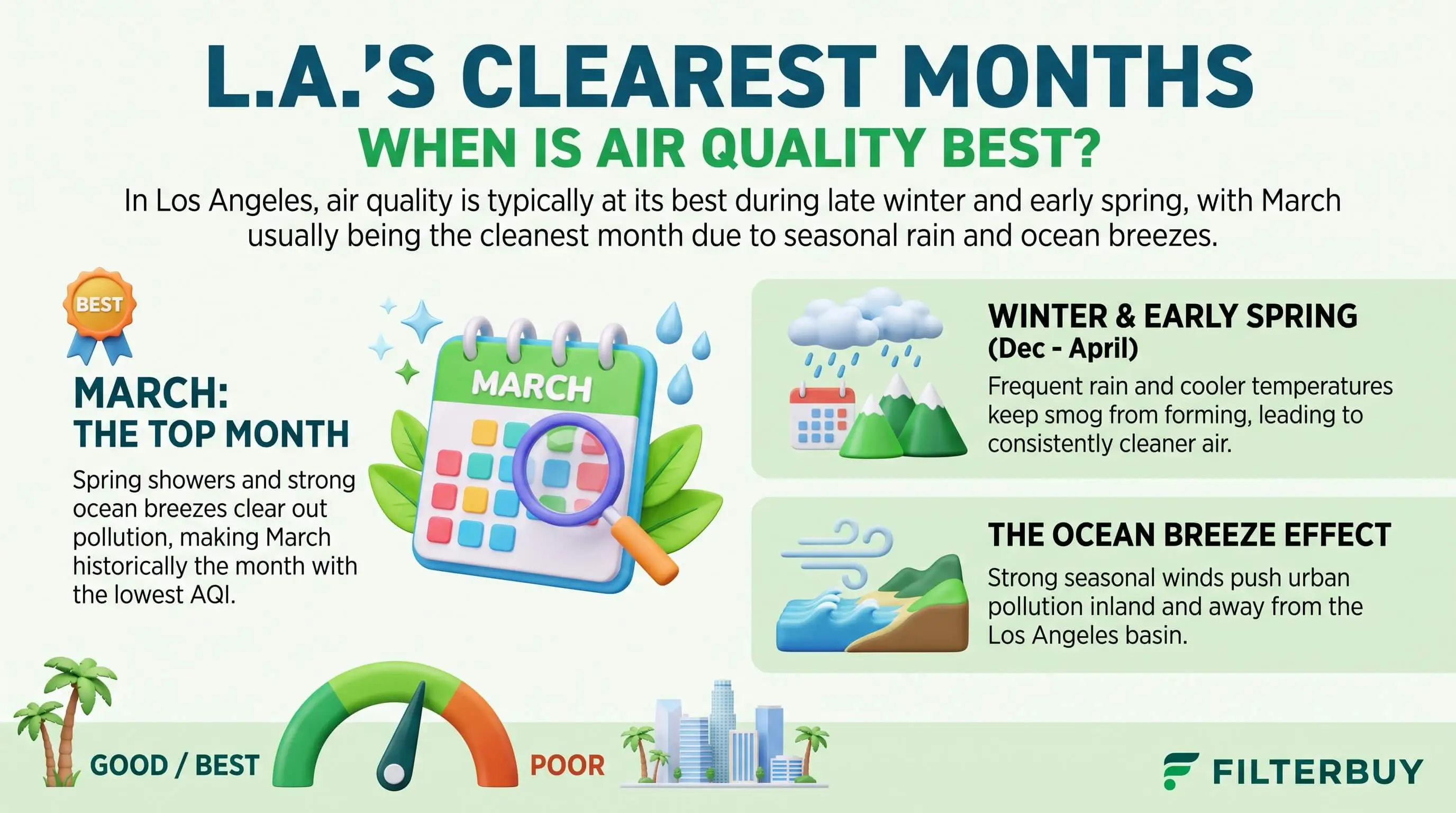
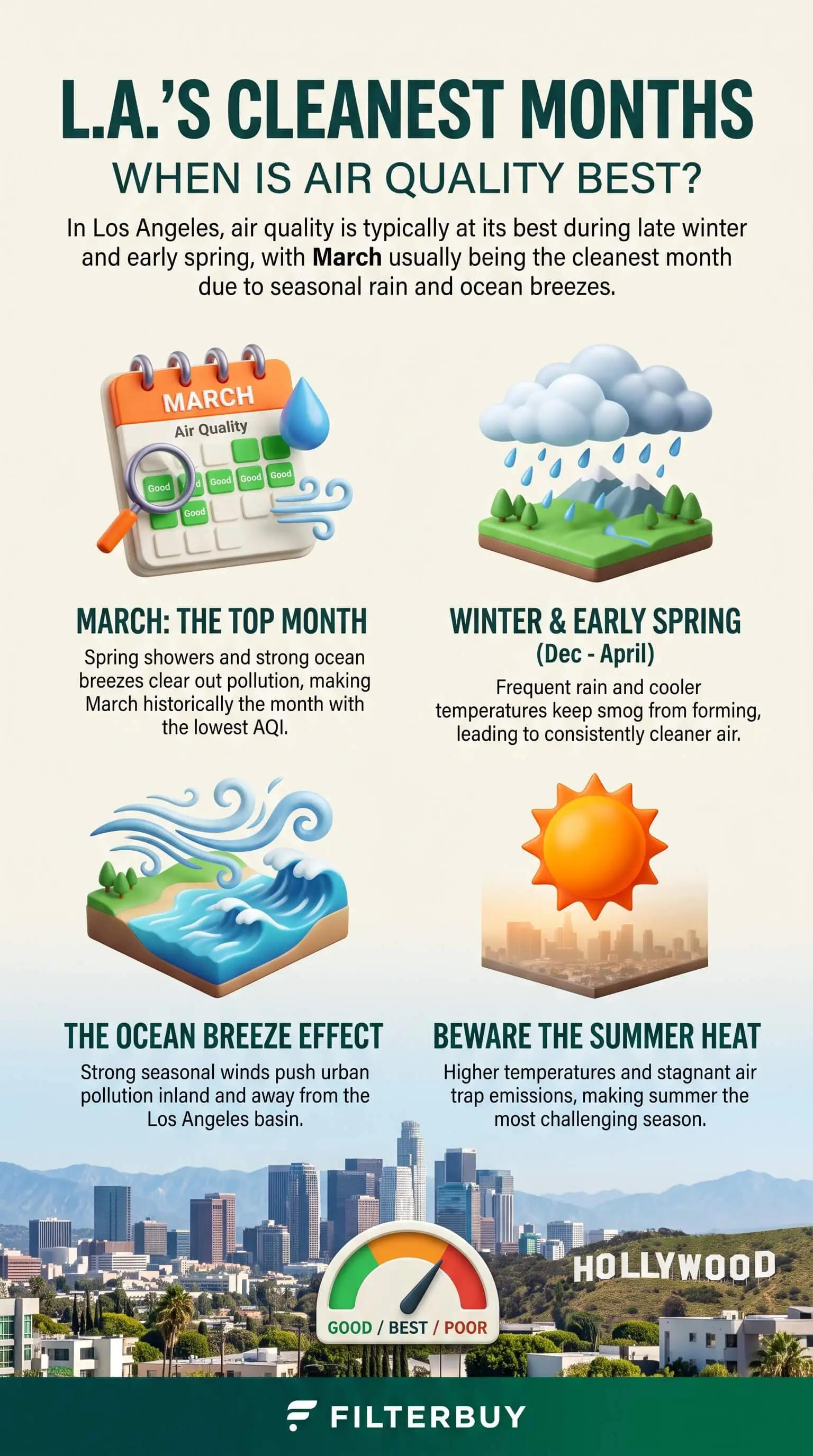
From October through February, Los Angeles County barely registers a bad air day. The sun sits lower and the days run shorter, so ozone has less to work with. Then the January and February storms roll in and rinse the basin. EPA's daily counts show zero unhealthy days in October 2025 and one apiece in November, January, and February, with December only slightly higher at three.
My pick for the single safest month is February. It lands near the peak of the rainy season and weeks ahead of the first real heat.
March and April: The Greenest Days, With a Catch
April 2026 gave the county 10 Good days, more than any other month in the past year. Rain-washed air and mild onshore breezes did most of that work.
March showed the other side of spring. An early heat wave pushed the county to 14 unhealthy days during the basin's smoggiest start to a year in more than a decade. How warm the season runs decides whether spring feels like a reward or a preview of August.
May Through September: Ozone Season
Summer is when the invisible problem turns visible. Long, hot days bake exhaust into ozone. A warm layer of air settles over the basin like a lid, and the mountains to the north and east block the way out. July and August 2026 each logged 21 unhealthy days and almost no Good ones.
The coast usually gets off easier than the valleys. All day long, the sea breeze shoves morning exhaust inland, so ozone in the San Fernando and San Gabriel valleys tends to peak in mid to late afternoon while Santa Monica stays clearer.
Why Winter Air Is Not Always Clean
A low count of bad days still leaves room for a bad night. Cool-weather air has a few tricks of its own.
Overnight inversions: On cold, calm nights, a shallow layer of air gets stuck near the ground and collects traffic and fireplace particles until the morning sun breaks it up.
Wood smoke: South Coast AQMD runs Check Before You Burn from November 1 through the end of February, and its No-Burn Days tend to land around the holidays, when the most fireplaces are lit.
Santa Ana winds: These dry offshore winds blow most often in winter and can turn one spark into a firestorm. The January 2025 fires proved that smoke doesn't check the calendar.
Don't take your indoor air for granted on winter days. A noon reading can look perfectly fine after your family spent the night breathing the roughest air of the day. Proper duct sealing can help prevent unfiltered air from entering your home's HVAC system.
Where You Live in Los Angeles Changes the Answer
Your ZIP code and the clock matter as much as the month.
Santa Monica and other beach towns usually see less ozone. Long Beach is the exception for particles, since ships and trucks working the port corridor add their own soot. The San Fernando and San Gabriel valleys sit downwind and take the brunt of summer ozone, and homes near the 405, the 710, or any major freeway breathe more traffic particles year-round. An HVAC air purifier ionizer may help improve indoor air quality, provided it does not produce harmful levels of ozone.
Because ozone builds all afternoon, an early August walk almost always beats one at 4 p.m.
How to Plan Around Los Angeles Air Quality
You're the one in your house who keeps things running, and planning around the air works the same way. Nobody can move the inversion layer, but you can choose when your family steps into it.
Check the hourly reading before outdoor exercise, since the daily summary hides afternoon peaks.
Move summer runs and yard work to before 10 a.m.
Use the clear days right after a winter storm, and leave the fireplace cold on No-Burn Days.
Close the windows when smoke drifts in or a hot afternoon pushes ozone up.
Flip your HVAC fan from Auto to On when readings climb so air keeps moving through the filter.
Pro Tip: Ozone breaks down fast indoors. Fine particles don't, and they linger in the air your family breathes. A pleated furnace filter catches far more PM2.5 than a basic one as long as your system is rated for it, so swap it in before smoke season rather than after the first advisory.
"After years of reading daily AQI data for the South Coast Air Basin, I tell people to watch the storm cycle instead of the season name. The cleanest days usually show up a day or two after a winter rain clears the basin, and the calm, cold night that follows can pin fireplace smoke near the ground by the next evening."
7 Essential Resources
Read the AQI the Way Forecasters Do
AirNow walks through daily forecasts and current readings so you can time outdoor plans around them.
Resource: https://www.airnow.gov/aqi/aqi-basics/using-air-quality-index/
See Why Summer Smog Hits Hardest
The California Air Resources Board shows why hot, calm days push ozone past health standards.
Resource: https://ww2.arb.ca.gov/resources/ozone-and-health
Put a Name to the Lid Over the Basin
The National Weather Service defines the temperature inversion that traps pollution over Los Angeles.
Resource: https://forecast.weather.gov/glossary.php?word=inversion
Understand the Winds Behind Winter Fires
Researchers mapped 65 years of Santa Ana winds in this NOAA-archived study and found the winds peak in winter.
Resource: https://repository.library.noaa.gov/view/noaa/20522
Know What to Do When Smoke Rolls In
Los Angeles County Public Health lists the indoor steps to take when a smoke advisory goes out.
Resource: https://lacounty.gov/2026/07/10/smoke-advisory-4/
Learn Who Smoke Affects Most
The CDC spells out who faces the highest risk from wildfire smoke and how to cut exposure at home.
Resource: https://www.cdc.gov/wildfires/risk-factors/index.html
Protect Family Members With Asthma
The Asthma and Allergy Foundation of America explains how ozone and particle pollution set off asthma symptoms.
Resource: https://aafa.org/asthma/asthma-triggers-causes/air-pollution-smog-asthma
3 Statistics
Summer Brings 21 Unhealthy Days a Month
EPA data shows Los Angeles County logged 21 unhealthy AQI days in both July and August 2026, against one each in November 2025, January 2026, and February 2026 and none in October 2025.
Source: https://www.epa.gov/outdoor-air-quality-data/air-quality-index-daily-values-report
Worst Ozone in the Nation for 26 of 27 Years
In the American Lung Association's State of the Air 2026 report, Los Angeles ozone got worse than the year before and ranked worst in the nation again, a spot the city has held in 26 of the report's 27 editions.
Source: https://www.lung.org/research/sota/key-findings
Fireplaces Rival Every Car in the Basin
South Coast AQMD estimates residential fireplaces release about five tons of PM2.5 a day across the South Coast Air Basin, roughly matching every passenger vehicle in the region, and that output can double during the winter burn season.
Source: https://www.aqmd.gov/home/research/pubs-docs-reports/newsletters/mar-apr-2023/cbyb-season-ends
Los Angeles faces serious air pollution challenges, with unhealthy summer AQI days, some of the nation's worst ozone pollution, and winter fireplace emissions adding harmful particles. Using a top air filter at home can help reduce indoor particle exposure when outdoor air quality deteriorates.
Final Thoughts and Opinion
If I had to circle one month, I'd circle February for the fewest bad air days and April for the most beautiful ones. Anyone timing a visit or a training plan gets the best odds in that late winter to spring window.
Still, no calendar guarantees clean air in this city. One March heat wave or one January Santa Ana fire can rewrite a month overnight. The habit I'd recommend here is the same one that works in Chicago and Boston. Check the live reading for the hour you'll actually be outside, and keep a fresh filter protecting the air inside your home.
Frequently Asked Questions
What is the cleanest month for air in Los Angeles?
February gives you the lowest odds of an unhealthy air day. Winter storms clear the basin, and the sun isn't strong enough yet to build much ozone. In recent EPA data, every month from October through February logged three or fewer unhealthy days in Los Angeles County, and April brought the most Good days.
What month has the worst air quality in Los Angeles?
July and August usually rank worst. Strong sun and heat turn exhaust into ozone, and a warm layer of air traps it over the basin. Each month logged 21 unhealthy days in Los Angeles County in 2026, and the inland valleys typically take the hardest hit in the afternoon.
Why is Los Angeles smog worse in summer?
Summer stacks every ingredient smog needs. Long, hot days give sunlight time to turn vehicle and factory exhaust into ozone. The mountains around the basin and a warm inversion layer keep that air from mixing out, and the afternoon sea breeze carries it inland toward the valleys.
Is air quality bad in Los Angeles during winter?
Winter brings the fewest unhealthy days overall, though it has weak spots. Cold, calm nights hold traffic and fireplace particles near the ground, especially over the holidays. Santa Ana winds can also drive wildfires that spread smoke across the region with almost no warning.
What is a good air quality index reading in Los Angeles?
Any AQI from 0 to 50 counts as Good, and 51 to 100 counts as Moderate, which works for most people. Past 100, children, older adults, and anyone with asthma or heart disease should shorten long or hard outdoor workouts. Using a MERV 8 filter in your HVAC system can also help capture airborne particles and improve indoor air quality.
Plan Your Days Around Cleaner Los Angeles Air
Los Angeles usually breathes easiest from late fall into early spring and struggles most under summer ozone. Check the live reading on the air quality index map los angeles before you head out, and keep a fresh filter working so the air inside your home stays cleaner in every season.