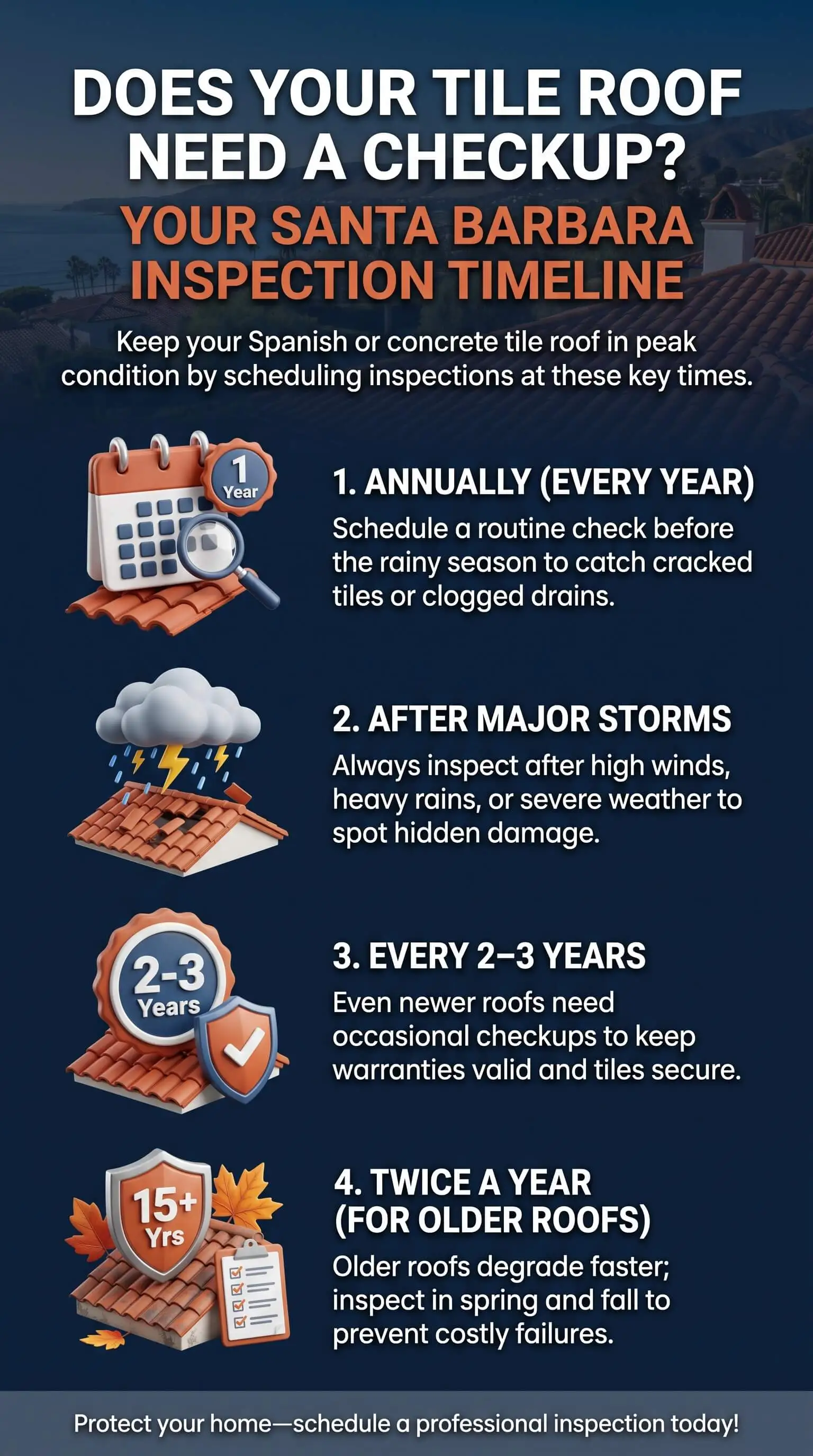
A clay tile roof can last half a century or longer. The waterproofing layer underneath it usually won't. That gap is the reason a Santa Barbara tile roof needs a professional inspection at least once a year, ideally in the fall before the rains, plus a follow-up check after any storm that brings heavy rain or strong wind.
The tile is about as durable as a roofing system gets, but it only sheds water. The underlayment keeps the house dry, and it ages out of sight beneath tile that can still look perfect from the driveway.
When you compare contractors for roofing Santa Barbara homeowners can count on, start with one question: will they check the layer under the tile? Anyone can spot a cracked tile. Worn underlayment, lifted flashing, or a failing vent boot tends to stay hidden until a stain shows up on the ceiling.
TL;DR Quick Answers
Roofing Santa Barbara
Good roofing in Santa Barbara starts with an honest inspection of the layer beneath the tile, because that hidden underlayment, not the tile itself, usually decides when a roof starts to leak.
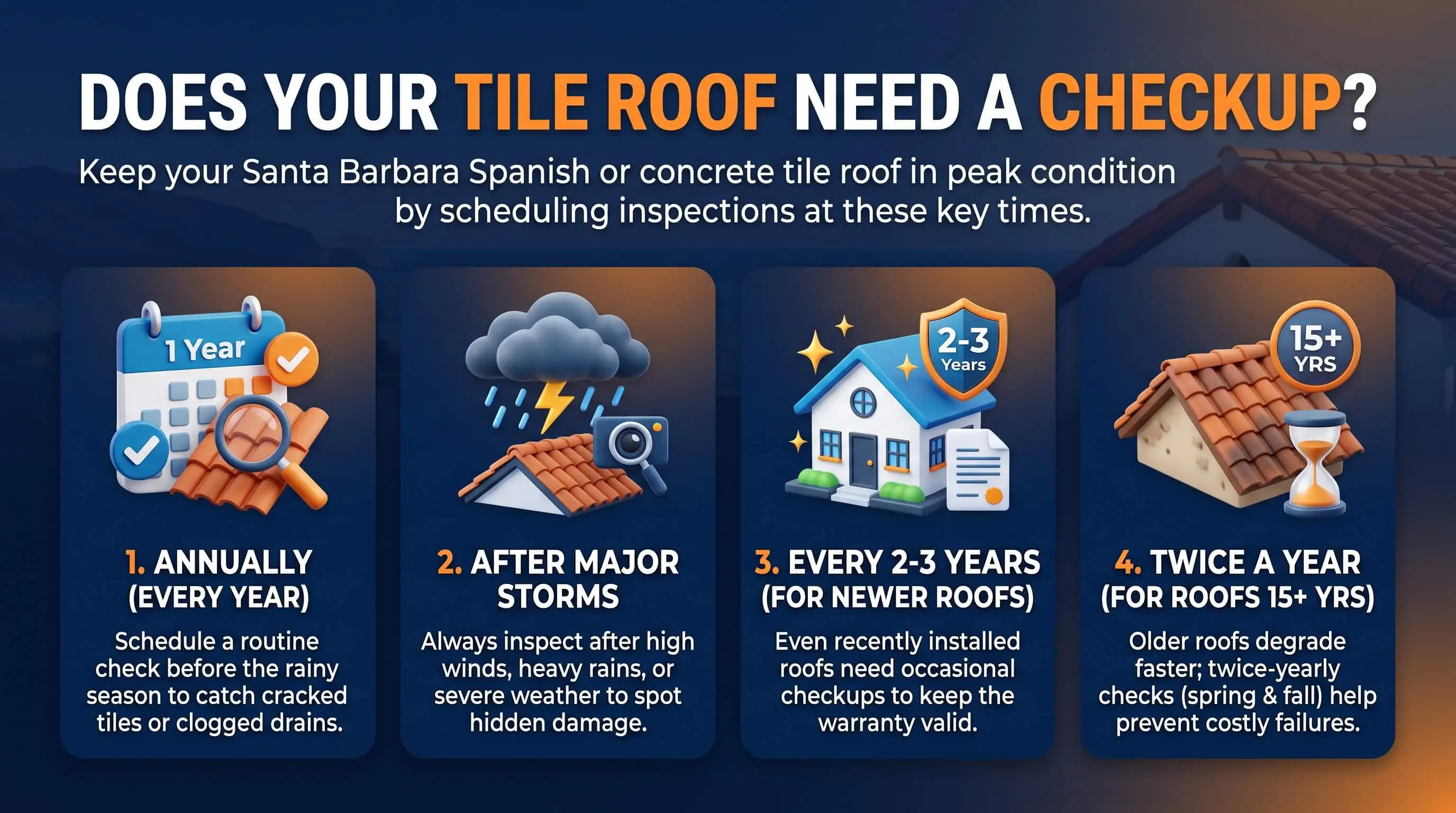
How often to inspect: Once a year, ideally in the fall before the rains, plus after major storms or high winds.
What lasts and what doesn't: Clay and concrete tile can last 40 to 100 years, while the underlayment beneath it wears out much sooner.
Local conditions to watch: Coastal salt air corrodes flashing, sundowner and Santa Ana winds slip tiles, and wildfire ash packs valleys and gutters.
Who to hire: A CSLB-licensed roofer who lifts tiles, photographs every concern, and puts findings in writing.
What to expect: Not every finding means the roof needs to be replaced. A clear report separates what needs attention now from what can be monitored.
Top Takeaways
Have a Santa Barbara tile roof professionally inspected at least once a year, ideally in the fall before the rainy season.
Add an inspection after major storms, high winds, fire season, and any HVAC, solar, or other work that puts someone on the roof.
The tiles usually outlast the underlayment beneath them, so a good inspection lifts a few tiles to check that hidden layer.
Most tile roof leaks start at flashing valleys, and penetrations like vents and HVAC roof jacks, not out in the middle of the tile.
Stay off the tile yourself. Hire a licensed contractor, verify the license with the CSLB, and ask for photos and written findings.
The Short Answer: Once a Year, Plus After Storms
Plan on one professional inspection a year, and add a check after any storm with heavy rain or strong wind. The National Roofing Contractors Association has long recommended looking at a roof twice a year, in spring and fall. For Santa Barbara tile, put the weight on the fall visit. It catches problems before the rainy season starts, and a lighter spring look confirms how the roof came through the winter.
Certain events call for a check no matter what the calendar says. A big wind event is one. So is a tree limb on the roof, a new solar array, or HVAC work that sent a technician walking across the tile.
Why Tile Roofs Need a Different Kind of Inspection
On a tile roof, the part you can't see sets the real lifespan. The tiles can go 50 years or more. The underlayment typically gives out much sooner, and how long it holds up depends on the product and how carefully the installer puts it down.
That gap shows up in two ways. Rain that slips past a cracked tile or an overloaded valley should run across the underlayment and off the roof edge, but once that layer dries out and turns brittle, the water reaches the roof deck instead. Good tile also hides a tired roof. A 30-year-old clay roof can look nearly new from the street while the layer beneath it is close to done.
So a proper inspection includes lifting a tile or two. The Tile Roofing Industry Alliance points to it as the simplest way to see the underlayment's condition firsthand.
Santa Barbara Conditions That Shorten the Schedule
Santa Barbara's weather is easy on people and harder on roofs than it looks. Put these local conditions on your inspection calendar.
Coastal salt air. Near the water, metal flashing, fasteners, and vent hardware corrode faster, and those parts usually fail long before the tile does.
A short, heavy rainy season. Most of the year's rain arrives over a few winter months, often in a handful of big storms. A roof that went eight months without water gets tested all at once.
Sundowner and Santa Ana winds. Strong gusts lift and slip tiles, especially along ridges, hips, and rake edges.
Wildfire ash and embers. Debris settles in valleys, gutters, and the open gaps under curved tile. CAL FIRE recommends sealing gaps under roof tiles and keeping roof debris cleared, which makes a pre-fire-season cleanout worth scheduling.
Hillside leaf litter. Homes in Montecito, Mission Canyon, and the Riviera often sit under oaks and eucalyptus. Packed valleys hold water against the underlayment until it backs up under the tile.
Where Your HVAC System and Tile Roof Meet
Every pipe, duct, or bracket that passes through a tile roof is a potential leak point. On many Santa Barbara homes, most of those penetrations belong to the HVAC system, from vent stacks and flue roof jacks to condensate lines and the mounts for rooftop units.
Two problems show up here more than anywhere else on the roof. The flashing and seals around penetrations age faster than the surrounding tile. And installers often add or service equipment after the roof goes on, working a trade that doesn't involve tile every day. One technician walking to a rooftop condenser can crack several tiles and never notice.
If your system has had recent work, or you're planning an upgrade, book a roof check once the job wraps up. It pairs well with the other steps homeowners take to extend the life of an HVAC unit, since a dry attic protects ductwork and equipment too.
Warning Signs That Should Move Your Inspection Up
Don't wait for the annual visit if you notice any of these.
Cracked, slipped, or missing tiles, especially in a line or near a vent
Valleys or gutters packed with leaves, ash, or broken tile pieces
Crumbling mortar along the ridge or hip lines
Rusted, lifted, or bent flashing at walls, chimneys, and skylights
Water stains or bubbling paint on ceilings or upper walls
Damp sheathing, a musty smell, or daylight in the attic
Not every finding means the roof needs to be replaced. Most of these point to a repair, and repairs cost far less when someone catches them early.
What a Professional Tile Roof Inspection Covers
A professional tile roof inspection looks at every layer of the roof and leaves you with a written record of what the inspector found. Please don't climb up and walk the tiles yourself. Clay and concrete tile can crack under one misplaced step, and a fall from a roof is a far bigger problem than a leak.
On a typical home, a thorough inspection takes about 60 to 90 minutes and covers the following.
Field tiles, ridge and hip tiles, and rake edges, checked for cracks, slips, and missing pieces
Flashing at valleys, walls, chimneys, skylights, and every penetration
The underlayment and battens, seen by lifting a tile or two
Gutters, drains, and valleys, checked for debris and drainage
The attic, checked for moisture, staining, and daylight
Photos and written findings that separate what needs attention now from what can be monitored
A contractor worth hiring will also tell you plainly when nothing needs to be done. On larger or hard-to-reach roofs, a drone can photograph the whole surface without anyone setting foot on fragile tile.
"When a homeowner calls us about a leak on a tile roof, they usually expect us to find a broken tile. Sometimes we do. But on the roofs we see across Santa Barbara, the leak more often traces back to the underlayment, a valley packed with leaves, or a vent somebody flashed years ago and never looked at again. Usually the tile is holding up fine, while the material under and around it has quietly worn out. That's why we lift tiles and check penetrations on every inspection, and why we photograph everything. A homeowner should see exactly what we saw and know what needs attention now and what can wait."
7 Essential Resources
These are the references we'd hand any Santa Barbara homeowner who wants to understand, maintain, and protect a tile roof.
Quality Roofing: Roof Inspections in Santa Barbara What a photo-documented inspection includes, how long it takes, and how the written report separates immediate needs from items to monitor.
Wikipedia: Roof A clear overview of how roofs are built and how different coverings, tile included, shed water. Good background before you talk with a contractor.
Tile Roofing Industry Alliance: Underlayment Q&A The tile industry's own answers on how long underlayment lasts beneath tile, and why the product and installation change that number.
Tile Talk: Maintenance Program (Tile Roofing Industry Alliance) A practical rundown of what a tile roof maintenance inspection should cover, from valleys and penetrations to lifting a tile to check the underlayment.
National Roofing Contractors Association The national trade association for roofing professionals, with a contractor search and technical guidance on roof systems.
CSLB: Check a Contractor License California's official license lookup. Confirm any roofer's license status, bond, and complaint history before they set foot on your roof.
CAL FIRE: Hardening Your Home State guidance on making a home more wildfire-resistant, including sealing gaps under roof tiles and keeping roof debris cleared.
Supporting Statistics
40 to 100 years: The typical service life of tile roofing. Clay or terra cotta tile generally lasts 40 to 60 years, and slate or concrete tile can last 50 to 100. That longevity is exactly why the parts under and around the tile deserve a closer look. [Source]
10 to 35 years: The range of underlayment lifespans homeowners hear quoted for tile roofs. The Tile Roofing Industry Alliance says no single answer fits every roof, because the underlayment type, the number of layers, and how long it sat in the sun before the tile went on all change the result. [Source]
Up to 20%: The potential discount on the wildfire portion of a California homeowners premium for documented home hardening, though savings more often land around 5 to 10%. An inspection record showing a sealed, debris-free tile roof helps make that case to an insurer. [Source]
Final Thoughts and Opinion
A tile roof suits Santa Barbara. It fits the architecture, handles the sun, and can outlast the mortgage. That durability is also the trap, because when the tile looks fine, it's easy to assume everything under it is fine too.
In our experience, the most expensive tile roof surprises start with that assumption. The weak link is rarely the tile. More often it's the underlayment, the flashing around a chimney, or a vent a technician stepped past on the way to the rooftop unit, and nobody sees any of those from the ground.
So here's where we land. One professional inspection a year is cheap insurance on a roof built to last generations. Book it in the fall before the rains, then add a check after big storms, after fire season, and after anyone has worked up there. If you're also considering top insulation installation, it's a good time to check the attic and roof area together for moisture, ventilation, or other issues that could affect both systems. And when you choose a contractor for roofing Santa Barbara homes depend on, pick the one who lifts tiles, photographs what they find, and tells you plainly when nothing needs doing. That last habit says a lot about the rest of their work.
Frequently Asked Questions
Can I inspect my tile roof myself?
You can do a useful visual check from the ground or from a ladder at the eaves. Look for cracked, slipped, or missing tiles, debris in valleys and gutters, and bent flashing, then check the attic for stains or damp spots after a rain. Don't walk on the tile. It cracks easily underfoot, and a fall is a serious risk. Leave the on-roof inspection to a licensed professional.
How long does a tile roof last in Santa Barbara?
Clay tile often lasts 40 to 60 years, and concrete tile can go 50 years or more. The underlayment beneath usually needs attention much sooner, depending on the material and how it was installed. Coastal salt air and seasonal storms also shorten the life of flashing and fasteners. Regular inspections let you replace the worn layer before it damages the roof deck.
How much does a tile roof inspection cost?
Pricing depends on the roof's size, pitch, access, and the reason for the inspection. A formal inspection with photos and a written report is typically a paid service, especially for real estate or insurance purposes. If you already know there's a leak or visible damage, a free repair estimate may be all you need. Quality Roofing, for example, quotes formal inspections based on the property and its purpose, and prices recommended repairs at no charge.
Do I need a roof inspection after HVAC or solar work?
Yes, it's worth doing. Installers and service technicians often walk across tile to reach rooftop equipment, and tile cracks under a misplaced step. New penetrations also need proper flashing to stay watertight. A quick inspection after the work catches broken tiles and sealing problems before the rains find them. If you're weighing an equipment upgrade or HVAC system installation, review whether it's time to replace your HVAC system and plan the roof check at the same time.
What is the difference between a roof inspection and a free roof estimate?
A roof inspection documents your roof's overall condition, with photos and written findings that note what needs attention now and what to monitor. It's the right choice for a home sale, insurance, or simple peace of mind. A free roof estimate prices a specific repair or replacement. If you already know what's wrong, start with an estimate. If you don't, start with an inspection.
Schedule Your Santa Barbara Tile Roof Inspection
If your tile roof hasn't had a professional look since last winter, the weeks before the first storm of the season are the right time.
Quality Roofing has worked on roofs across Santa Barbara County since 1996, with more than 10,000 roofs serviced and a license in good standing (CSLB #504492). Every inspection includes photos of each concern and a written report in plain language, usually within 2 to 3 business days. If the report recommends repairs, the estimate is free.