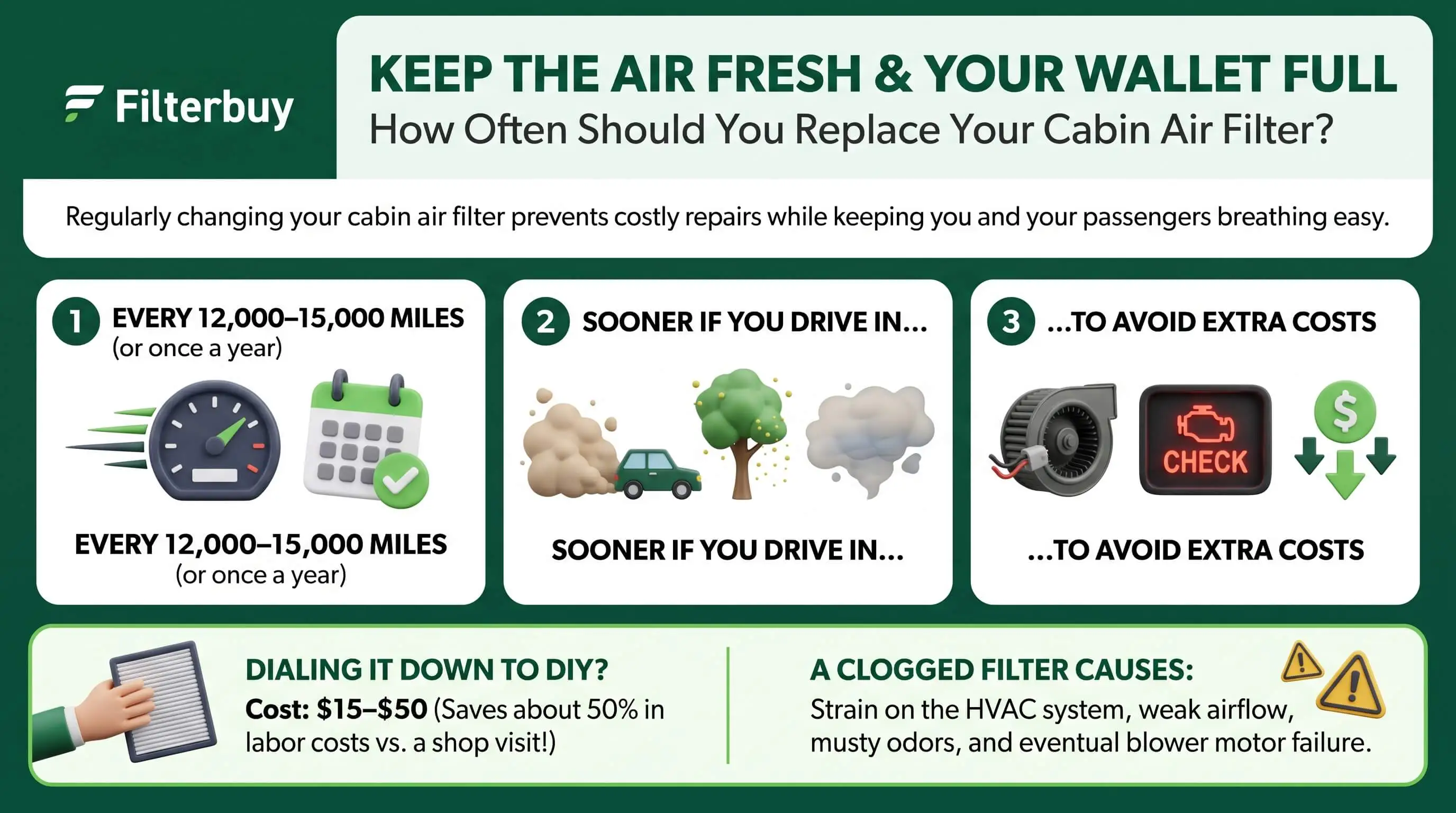
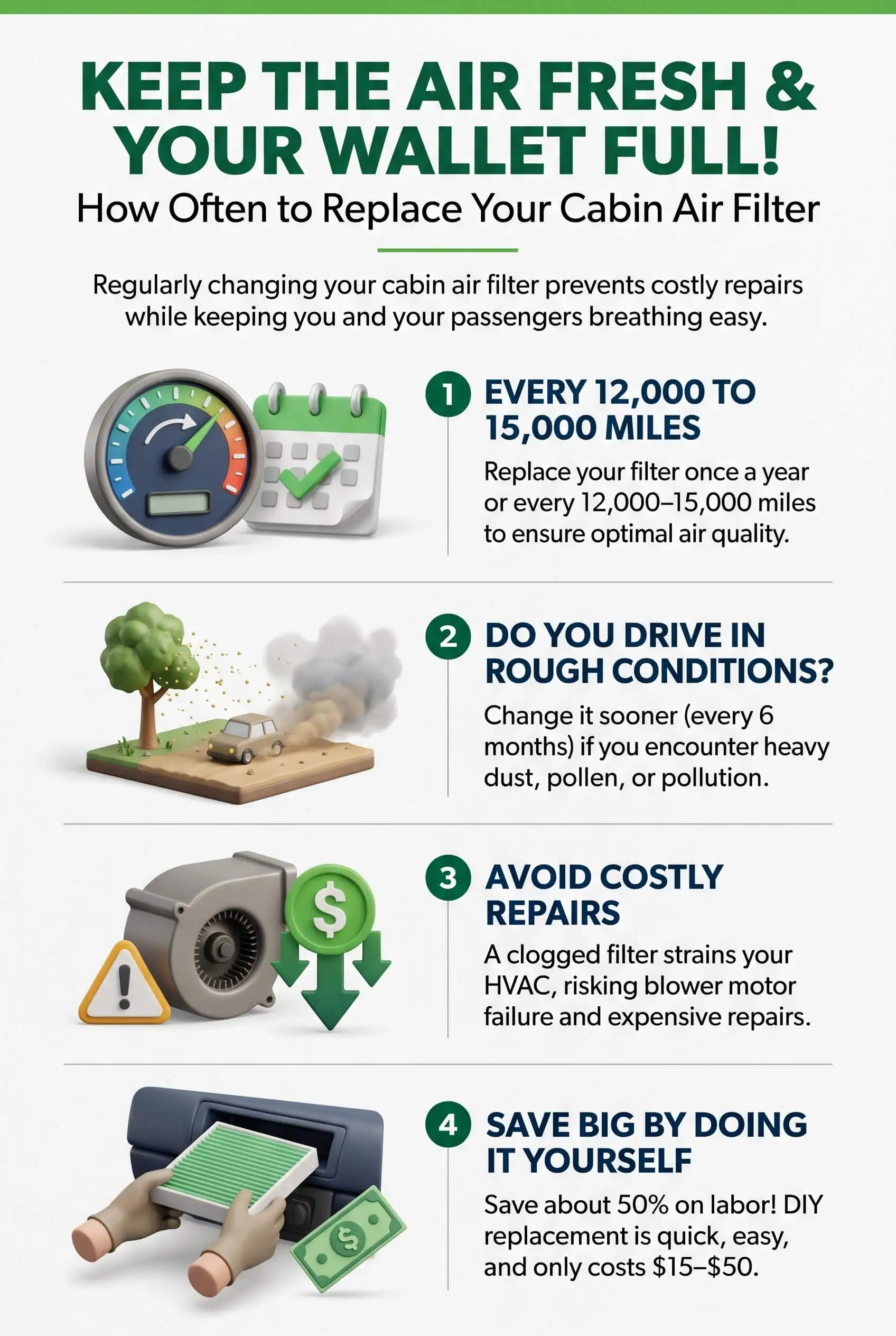
Drop the glove box on a car that's skipped a few filter changes, and there's a good chance you'll find a gray mat of dust, leaves, and pollen sitting right where your cabin air comes in. Every breath you take on the road passes through that mat. Replace your cabin air filter every 12,000 to 15,000 miles or once a year, whichever comes first, and sooner when you drive through smoke, dust, or a heavy pollen season.
Getting that timing right is how you keep your cabin air filter replacement cost small. Swap too often and you pay for filter life you never used. Wait too long, and a cheap part can turn into a much bigger repair.
TL;DR Quick Answers
cabin air filter replacement cost
A cabin air filter replacement costs about $15 to $50 if you do it yourself and roughly $60 to $130 at a shop, where labor makes up about half the bill. Timing matters as much as price: replacing it once a year, or every 12,000 to 15,000 miles, keeps it around a penny a mile or less.
Do it yourself: $15 to $50 for the filter alone. Most sit behind the glove box and swap out in minutes.
Shop or dealer: $60 to $130, with labor making up about half the total.
Cost per mile: A $25 filter you change yourself every 12,000 miles works out to about two-tenths of a cent per mile.
Replacing too early: You pay for filter life you never used.
Replacing too late: A clogged filter strains the blower motor, and that repair costs far more than the filter.
Top Takeaways
The standard interval: Replace it every 12,000 to 15,000 miles or once a year, whichever comes first.
Why yearly works: The average driver covers about 13,476 miles a year, right inside that window.
Early swaps waste money: Ask to see the old filter before you pay for a new one at every oil change.
Late swaps cost more: A clogged filter strains the blower motor and weakens your heating and cooling.
Harsh conditions shorten the clock: Check every six months if you drive through smoke, dust, heavy traffic, or pollen.
What a Cabin Air Filter Actually Does
Your car breathes through a cabin air filter. It's a pleated filter tucked into the outside-air intake for the passenger compartment, and in the UK most people call it a pollen filter. Every bit of outside air your vents push into the cabin goes through it first, so it's the one thing standing between you and the dust, pollen, soot, and road grime your car drives through every day.
Most cabin filters catch particles only. Some add a layer of activated carbon that also soaks up odors and gases like exhaust fumes. Carbon filters cost a little more, and they wear out on a different clock, which comes up again when we get to driving conditions.
Where the 12,000 to 15,000 Mile Rule Comes From
Open your owner's manual to the maintenance schedule and you'll almost always find the cabin filter listed somewhere between 12,000 and 15,000 miles or 12 months. That window fits how Americans actually drive. The average driver logs about 13,476 miles a year, so for most of us, once a year is both the easiest schedule to remember and the right one.
Your manual still gets the final say. A few vehicles call for a shorter interval. Others say "inspect" instead of "replace," and that's worth knowing before anyone recommends a new filter.
How Timing Changes Your Cabin Air Filter Replacement Cost
Treat each swap as a fixed charge. The filter and the labor cost about the same at 8,000 miles as they do at 20,000, so the interval you choose decides what you spend each year and whether you get full value from every filter you buy.
Replacing Too Early
Some shops recommend a new cabin filter with every oil change. Agree every time and you could buy two or three filters a year when one would cover you. Ask to see the old one first. If it still looks light and the pleats are mostly clear, it has life left.
I'd make one exception, and it's when clean air matters more than the money. Smoke season, a passenger with allergies, or a stale smell you'd rather not breathe all justify an early swap.
Replacing Too Late
A clogged filter starves your heater core and evaporator of air, so the system works harder and delivers less. You feel it as weak airflow, slow cooling, and windows that take forever to clear. Keep driving on it and the blower motor takes the strain, and a blower repair costs far more than any filter. Plenty of expensive car repairs follow that same path, starting as small maintenance someone put off.
The Cost Per Mile of Staying on Schedule
Running the numbers and staying on schedule looks cheap. A $25 filter you install yourself every 12,000 miles works out to about two-tenths of a cent per mile. Have a shop do it for around $100 and you're still under a penny a mile. Those are example figures, not quotes. They still make the case, because fixing what a neglected filter causes costs far more than replacing it on time.
Driving Conditions That Shorten the Interval
The standard interval assumes ordinary roads and ordinary air. If your driving looks like any of the situations below, check your filter every six months instead of once a year.
Wildfire smoke: Fine smoke particles load filter media fast, especially when your fan pulls in fresh outside air.
Gravel, dirt, or construction zones: Coarse dust packs the pleats quickly.
Heavy stop-and-go traffic: You spend more time breathing the exhaust of the car ahead of you.
High pollen seasons: A bad spring or fall can coat a filter in a few weeks.
Pets or allergy-prone passengers: Clean cabin air matters more, so an earlier swap earns its cost.
Carbon filters: Activated carbon fills up as it absorbs gases, so odor control usually fades before particle filtering does. When smells come back after a few months, the carbon is likely spent.
Signs Your Filter Is Due Before the Odometer Says So
Your car usually tells you before the mileage does. Watch for these:
Weak airflow from the vents, even with the fan on high
A musty or sour smell when the fan kicks on
Windows that fog up and stay foggy
A whistle from behind the dash or glove box
Leaves, debris, or a dark gray face on the filter when you pull it
Checking takes a few minutes on most cars, since the housing usually sits right behind the glove box. Your owner's manual shows the exact spot.
"After years of pulling cabin filters, the pattern I see most is a driver who skipped one change and now wonders why the AC feels weak in July. A packed filter chokes airflow across the evaporator, so the blower works harder and the cabin still won't cool evenly. One on-time filter costs less than all that strain."
Essential Resources
Cabin air filter replacement cost: See current shop and do-it-yourself price ranges, how the bill splits between parts and labor, and how to spot a padded quote.
FTC: Auto Repair Basics: Learn what a written estimate should show, why your manufacturer's schedule matters, and what to ask when a shop suggests extra service.
California Air Resources Board: Reducing Air Pollution Exposure in Passenger Vehicles: In road tests, high-efficiency cabin filters cut ultrafine particles by about 90%, while standard in-use filters managed about 50%.
NIH: Randomized Study of In-Vehicle Cabin Air Filtration: Researchers following rush-hour commuters found cabin filtration lowered their particle exposure by almost a third.
CDC Stacks: High Efficiency Cabin Air Filter Study: With windows closed and high-efficiency cabin filters installed, drivers breathed 37% less PM2.5 and 47% fewer ultrafine particles.
EPA: Reduce Your Smoke Exposure: The EPA explains how to keep smoke out of your car, starting with closed windows and the AC set to recirculate.
Minnesota Department of Health: Stay Safe When It's Smoky: A one-page smoke-day checklist, including how to set your car's ventilation.
Supporting Statistics
13,476 miles. The average American driver covers this distance in a year, which lands right inside the 12,000 to 15,000 mile cabin filter window. (Federal Highway Administration)
60.4 minutes a day. American drivers spent this long behind the wheel each day in 2024, covering about 31.1 miles. That's an hour of breathing whatever your cabin filter lets through. (AAA Foundation for Traffic Safety, American Driving Survey 2024)
4.9%. Motor vehicle maintenance and repair prices climbed this much from January 2025 to January 2026, more than any other item in that month's price growth. Put off maintenance, and the repair waiting for you keeps getting pricier. (Bureau of Transportation Statistics)
With Americans driving an average of 13,476 miles annually and spending about an hour on the road each day, timely cabin air filter replacement helps maintain cleaner air inside vehicles and control maintenance costs. Just as MERV 8 pleated furnace air filters help capture airborne particles in homes, cabin air filters serve a similar purpose in cars, making regular replacement an important part of air quality maintenance.
Final Thoughts
My take is that the smartest way to handle a cabin air filter is also the most boring one. Look at it once a year, replace it when your manual or your driving says it's time, and pass on the extra swaps nobody can explain. The filter is one of the cheapest parts on your car, so your savings come from timing, not from hunting down a lower price.
I'll take five minutes behind the glove box over a blower motor bill or a July of lukewarm AC every time. Stay on schedule and adjust for smoke and dust, and your cabin air filter replacement cost stays small and predictable.
Frequently Asked Questions
How much does a cabin air filter replacement cost?
Doing it yourself usually runs $15 to $50, since you only buy the filter. At a shop, expect roughly $60 to $130, and labor makes up about half of that bill. Your vehicle model and how hard the filter is to reach both move the final price.
Can a dirty cabin air filter hurt my car's AC?
It makes your AC work harder. A clogged filter restricts airflow across the evaporator and heater core, which weakens cooling and heating and puts extra strain on the blower motor. A fresh filter usually brings airflow back to normal.
Is replacing a cabin air filter once a year enough?
For most drivers, yes. A yearly change lines up with the 12,000 to 15,000 mile interval at average annual mileage. If you drive through wildfire smoke, dusty roads, or heavy pollen, check it every six months instead.
Do electric vehicles need cabin air filter replacements?
Yes. An electric vehicle still pulls outside air into the cabin through an HVAC intake, so its filter collects the same dust, pollen, and smoke as any other car. Check your owner's manual for the interval, which often matches gas vehicles.
Can I clean and reuse a cabin air filter?
Most cabin filters use disposable pleated media that can't handle washing. Vacuuming pulls off surface debris only, can damage the media, and won't revive a spent carbon layer. A replacement is the option you can count on.
Keep Your Cabin Air Filter on Schedule
You're the one who keeps the air in your car clean, and a yearly check plus an on-time swap keeps that job easy and your costs predictable. Replacing an AC air filter is part of that routine. Add your next change to your maintenance log, and let your mileage and driving conditions set the timing from there.


